A client came to us with a painful update: “My mortgage application was rejected.” The bank’s response was brief—mortgage declined due to affordability documentation.
But here’s the truth: in the UAE, most mortgage rejected cases are fixable when you tackle the two things banks measure hardest:
- Debt Burden Ratio / debt-to-income ratio mortgage
- Document quality (not just “having documents”, but having them bank-ready)
The hidden logic behind “mortgage declined”
The client believed their income was strong enough, and their monthly EMIs “weren’t that high.” The bank disagreed because of two common UAE realities:Reality 1: DBR is capped at 50% (and banks follow it)
UAE banks cap DBR at 50%. Many banks explicitly reference this cap when explaining lending decisions.Reality 2: DBR includes more than your active EMIs
In UAE DBR calculations, banks often include:- all EMIs plus
- 5% of the total credit card limit (even if the card balance is low)
The client’s situation (Day 0)
Profile: Salaried expat, stable employment Goal: Buy a ready property Result: Home loan rejectedWhat they submitted (and why it wasn’t enough)
They provided “documents,” but the bank wanted a clean pack aligned to the bank’s process:- Banks typically request a valid ID set, salary proof, debts/liabilities, and bank statements (varies by stage).
- Some banks explicitly ask for liability letters and six months original bank statements.
The rejection reasons (what we diagnosed in 30 minutes)
1) DBR was above the limit once the mortgage EMI was added
This wasn’t a “credit score problem.” It was affordability math. From Emirates NBD’s explanation:- DBR = total recurring monthly debt ÷ gross monthly income
- total recurring debt includes all EMIs + 5% of total credit card limits
- DBR is capped at 50%
2) Liabilities weren’t clearly disclosed (big red flag)
Banks ask for “details of any debts” even for mortgage pre approval documents (Approval in Principle stage). The client had:- multiple cards
- a personal loan
- a car loan …but no clear one-page liabilities breakdown, and the bank statements didn’t make it easy to verify.
Why the mortgage application was rejected?
Here’s the affordability picture the bank likely modeled: Gross monthly income: AED 30,000 Existing commitments- Car loan EMI: AED 2,500
- Personal loan EMI: AED 3,500
- Total credit card limits: AED 80,000
- Bank DBR assumption: 5% × 80,000 = AED 4,000/month
What we did differently (the 7-day turnaround plan)
Day 1 — Build the “bank view” (DBR + liabilities + documents audit)
We did three things immediately:- DBR audit using the UAE method (including credit card limits)
- Built a liabilities list that matched how lenders verify debt (cards/loans/instalments)
- Rebuilt the “document story” so salary + statements + liabilities read cleanly
Day 2 — Reduce DBR fast (the 2 fastest levers)
To reduce DBR, we target what changes the ratio quickly without waiting months.Lever A: Reduce credit card limits (not just balances)
Because banks can count 5% of total limits, lowering limits can instantly reduce “assumed monthly debt.” We helped the client:- keep 1–2 cards
- reduce limits on unused cards
- remove “extra” limits that were hurting affordability
Lever B: Remove one EMI that was pushing DBR over 50%
We focused on the EMI with the worst “benefit vs damage” ratio:- small enough to close quickly
- large enough to change DBR meaningfully
Day 3 — Rebuild the mortgage documents checklist
Instead of uploading files randomly, we built a clean pack aligned to what UAE banks ask. Example: HSBC UAE- For Approval in Principle: ID + salary certificate + details of debts
- For full application: personal bank statement (past 6 months) + salary certificate + down payment proof + property docs
- last six months original bank statements + salary certificate + liability letter + purchase contract/down payment receipts
- latest salary certificate + latest 6 months bank statement + AECB credit bureau report preferred
Day 4 — Fix the #1 “silent rejection trigger”: unclear liabilities
We created a one-page “Disclosure of Liabilities” sheet (simple, but powerful):- Loan type (car/personal/etc.)
- EMI amount
- bank name
- remaining tenor (if known)
- credit cards: limits + bank names
- any instalment plans
Day 5 — Avoid the “multiple applications trap”
Many people apply to 3–6 banks after rejection. That can backfire. For example, HSBC notes that:- Full mortgage application includes a credit bureau check
- the check is recorded on Al Etihad Credit Bureau and visible to other companies
- but Approval in Principle does not impact your credit score
Day 6 — Submit the corrected file (with DBR proof page)
We submitted:- documents pack
- liabilities disclosure
- DBR calculation summary (before/after)
- explanation of changes made in 7 days
Day 7 — Approved (DBR under control + documents clean)
After limit reductions + EMI fix: New credit card limits: AED 25,000 Assumed monthly debt: 5% × 25,000 = AED 1,250 New recurring debt- Car EMI: 2,500
- Card assumption: 1,250 Total = 3,750
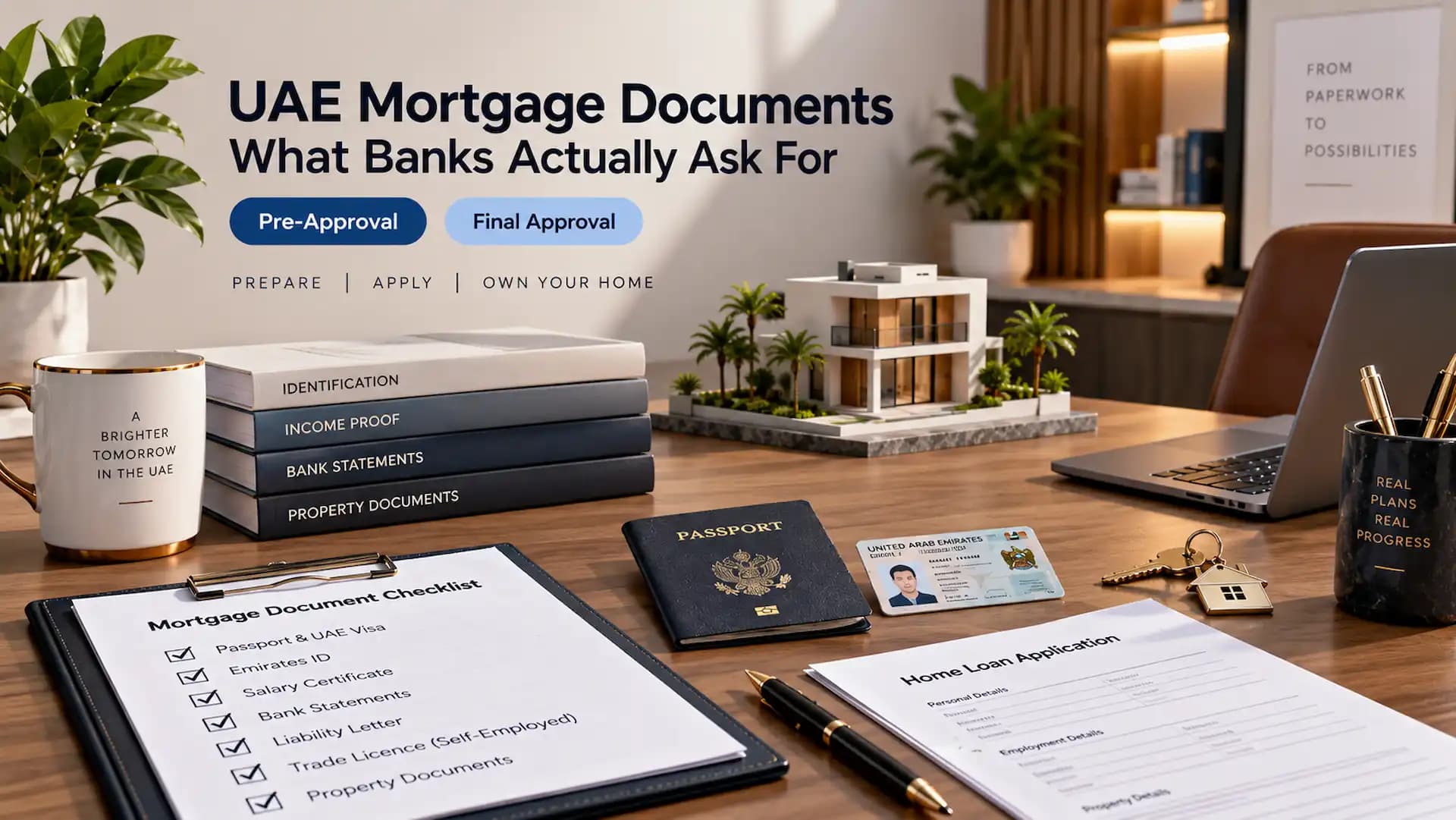
The “copy-paste” mortgage documents checklist
Use this as your base. It matches common UAE bank expectations (and lines up with HSBC/Mashreq/ADCB requirements).Mortgage pre approval documents
- Passport + visa + Emirates ID
- Salary certificate
- Details of any debts (loans/credit cards)
Full mortgage application documents
- Personal bank statement (typically last 6 months)
- Salary certificate (recent)
- Liability letter / liabilities proof (requested by some banks)
- Proof of funds for down payment
- Property documents / purchase contract (as applicable)
- AECB credit report (preferred by some banks)
Why mortgage applications get rejected
If you’re searching why mortgage applications get rejected, these are the repeat offenders:- DBR above 50% (DBR 50% rule)
- Credit card limits inflate DBR (5% of limits counted)
- Missing/unclear bank statements required for mortgage
- Failure to disclose liabilities mortgage clearly (no one-page summary)
- Multiple full applications causing repeated bureau footprints (varies, but some banks explicitly warn checks are recorded)
Practical DBR reduction strategies
If your mortgage declined due to affordability, here’s how to reduce DBR quickly:- Reduce credit card limits (not only balances) because limits affect DBR assumptions.
- Close/settle one EMI that pushes you past 50% (often a personal loan or instalment plan)
- Pause new credit activity before applying (especially multiple full applications).
- Make your bank statements “underwriter friendly” (clear salary credits, fewer unexplained transfers)