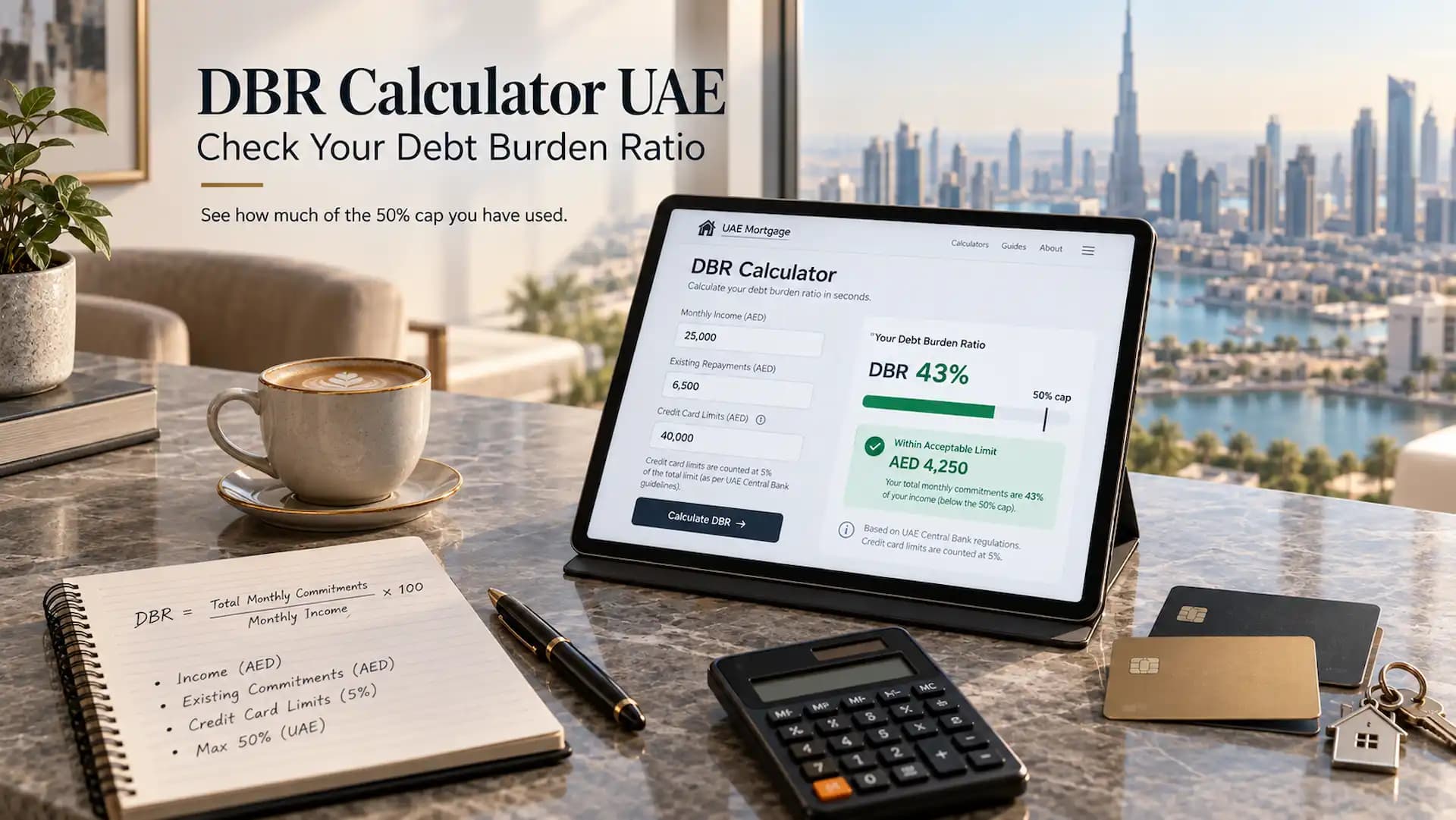
Two things usually surprise people. How much of the ceiling is already gone, and how much of that is credit cards they barely use.
The calculator below differs from most in two ways, and both matter. It applies the stress test banks actually use rather than the rate you were quoted, and it shows the income multiple cap alongside your affordability figure so you can see which of the two is binding. Almost every online DBR tool shows only the first, which produces a number no underwriter would accept.
Debt burden ratio calculator
Enter your income and existing commitments to see how much of the 50% cap you have already used, and what is left for a mortgage payment.
Within the cap, with room to spare.
- Your 50% ceiling
- AED 12,500
- Credit cards counted at 5% of limits
- AED 3,000
- Total existing commitments
- AED 5,000
- Left for a mortgage payment
- AED 7,500
- Loan your affordability supports
- AED 1,165,157
- Income multiple cap (7× annual)
- AED 2,100,000
- Your binding limit
- AED 1,165,157
Affordability is the limit that binds here. Your maximum loan is the lower of the two, before loan-to-value is applied.
The loan figure is calculated at a stressed rate of 5.99%, two percentage points above the rate you entered, because that is how banks assess affordability. Indicative only.
The formula, precisely
DBR = (total monthly debt commitments ÷ gross monthly income) × 100
Simple arithmetic. What makes it go wrong is what people put into it.
What counts as income
Gross monthly salary, before deductions, as stated on your salary certificate. With no personal income tax in the UAE, gross and net are usually identical on an expat salary.
Guaranteed, documented allowances count in full. Bonuses and commission are accepted only partially after a bank reviews consistency. Self-employed income is typically averaged over six to twelve months, then reduced by a haircut before the calculation begins.
What counts as a commitment
Every fixed monthly repayment: car loans, personal loans, other mortgages, and any facility with a scheduled instalment. Plus the new mortgage payment you are applying for.
Then credit cards, which are counted notionally at roughly 5% of your total limit, regardless of balance. This is the input people get wrong most often.
Why the loan figure uses a higher rate than you entered
Banks do not assess affordability at the rate they quote. UAE Central Bank mortgage rules require a stress test at two to four percentage points above the current rate. This calculator uses two points, the conservative end.
On AED 7,500 a month over 25 years, a 3.99% rate might look like it supports about AED 1.42 million. Stressed at 5.99%, the figure a bank actually works to is closer to AED 1.17 million.
Two caps, not one
Your maximum loan is the lower of the DBR cap (50% of gross income minus commitments) and the income multiple cap — roughly seven times annual income for expats and non-residents, and eight times for UAE nationals.
A third limit then applies on top: loan-to-value, which caps borrowing as a percentage of the property value. That depends on the property, so it is not in the calculator.
Reading your result
Under 40%. Comfortable. Banks describe this range as the one that moves fastest through approval.
40% to 50%. Inside the regulation but tight. Several lenders set internal ceilings below 50%.
Over 50%. No UAE bank can lend on those figures until commitments come down.
Five mistakes when calculating your own
- Using your card balance instead of your limit.
- Forgetting a facility on your credit bureau report.
- Using the headline rate instead of the stressed reversion rate.
- Assuming a limit reduction is instant — wait a full billing cycle before applying.
- Treating the result as the final loan — valuation and LTV can shrink it again.
Turning an estimate into an answer
Which bank will lend depends on your employer, credit file, income type and the property. We compare across 15+ UAE lenders and can tell you what your file supports.
Get pre-approved, or cross-check limits on the eligibility calculator.