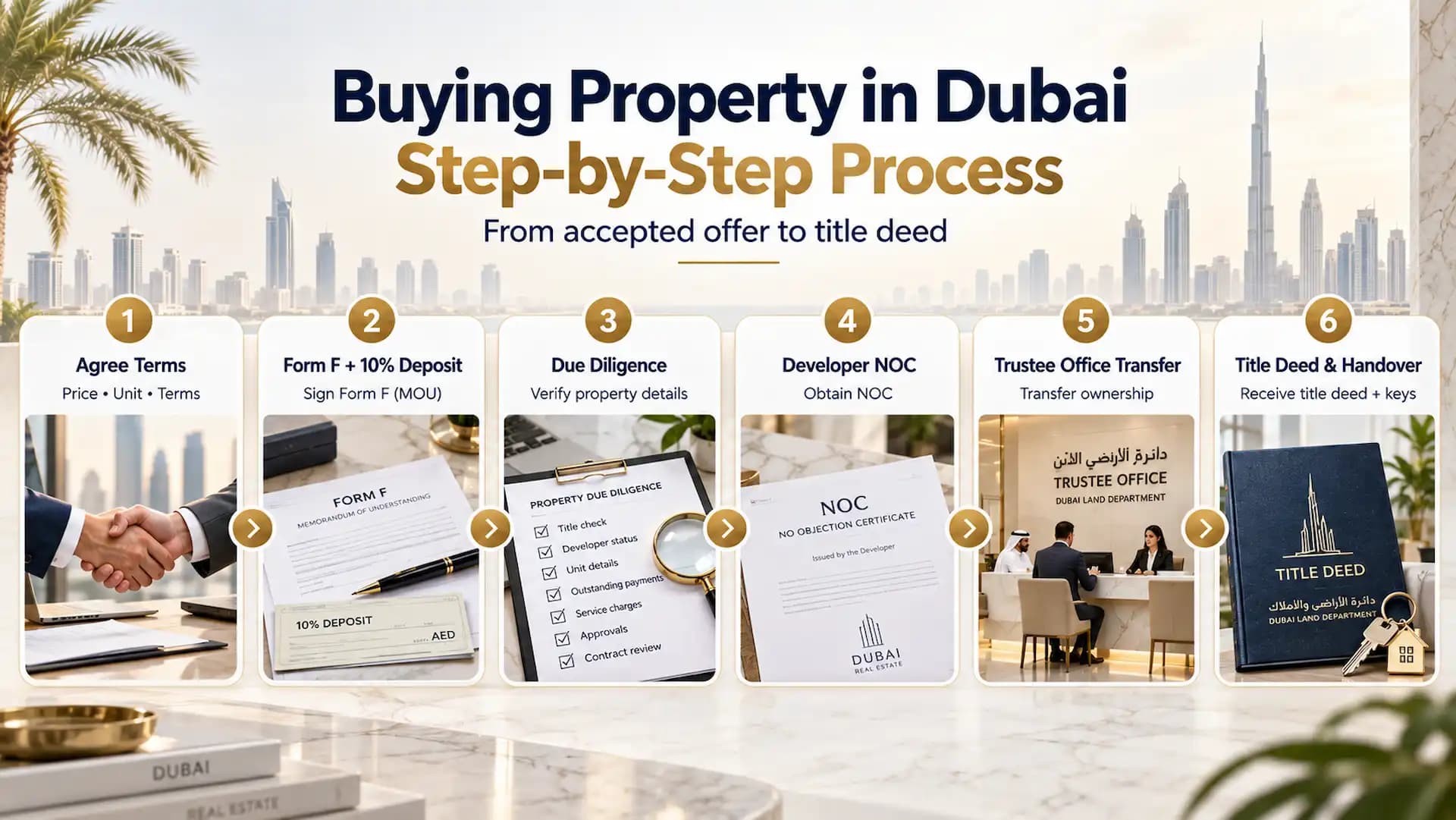
Buying property in Dubai runs on a tightly specified sequence. Form F, deposit, developer NOC, trustee office, title deed. Every transfer in the emirate goes through the same handful of checkpoints, which is why the process is more predictable here than in most markets once you know the order.
The transfer appointment itself takes 30 to 60 minutes and almost never goes wrong, because by the time you reach the counter everything has already been verified. The work sits upstream. Deals fail over an unpaid service charge blocking an NOC, a cheque made out to the wrong party, or an expired Emirates ID nobody checked.
This guide walks the transaction from accepted offer to title deed, plus the parts most guides stop short of: what to physically bring on transfer day, which cheques go to whom, and what you still need to do in the week afterwards. If you’re financing the purchase, our guide to getting a mortgage in Dubai covers the lending side that runs in parallel.
Your bank brings the cheque for the mortgage amount if you’re financing. Smaller items — title deed certificate, map fee, administrative charges — are often payable by card at the counter.
Get the amounts confirmed in writing before the cheques are issued. A cheque for the wrong amount cannot be corrected on the day.
The process at a glance
| Step | Who drives it | Typical duration |
| Agree terms, verify agent | You and the seller | Days |
| Sign Form F, pay 10% deposit | Both parties | Same day |
| Due diligence | You | 3–7 days |
| Developer NOC | Seller | 3–7 working days |
| Mortgage settlement, if any | Both banks | 1–2 weeks |
| Transfer at trustee office | Everyone | 30–60 minutes |
| Utilities, Ejari, handover | You | Days after |
Who’s actually involved
Worth knowing who does what, because responsibility for each step sits in a different place.- The Dubai Land Department (DLD) is the government registry. Every transfer, mortgage and title deed passes through it. The 4% transfer fee is theirs.
- Registration trustee offices are licensed private centres that physically execute transfers on the DLD’s behalf. Their service fee is separate from the 4%, and paying one doesn’t replace the other.
- RERA is the regulatory arm governing brokers, listings and escrow accounts.
- Your agent must be RERA-registered with a valid broker ID. Only a licensed brokerage can prepare Form F.
- The developer issues the NOC confirming service charges are clear. Without it the DLD won’t register anything.
- A conveyancer, if you appoint one, project-manages the whole thing. Optional, and worth it on higher-value or mortgaged transactions where the sequencing gets complicated.
Step 1: Agree terms and check who you’re dealing with
Before anything is signed, verify the agent is RERA-registered and holds a valid broker ID. Only a licensed broker working under a licensed brokerage can legally produce a Form F, so an unlicensed intermediary can’t complete your transaction no matter how helpful they seem. One rule that changed recently and catches sellers out: a property can be listed with a maximum of three registered brokerages, each under a signed Form A. Signing with five or six agents is no longer permitted and creates commission disputes at exactly the wrong moment. Form A itself carries a maximum validity of 90 days under RERA rules. If you’re buying and paying the commission, confirm in writing who pays what before terms are agreed. It’s conventionally 2% from the buyer, but the listing agreement governs.Step 2: Sign Form F and pay the deposit
Form F is the standard sale contract issued by the DLD. People call it the MOU, and functionally it serves that purpose, but it’s a unified government contract rather than something drafted by your agent. It can be signed digitally through the Dubai REST app or in person at a trustee office.What Form F actually does
It converts a negotiation into a binding contract. There’s no separate main agreement that follows — Form F is the contract, and everything after it is execution. It records the property details, the price, the deposit, the target transfer date, both parties’ identification, the brokers involved, and the consequences of default. It also allocates obligations: who obtains the NOC, who clears service charge arrears, who hands over vacant possession.The deposit
Conventionally 10% of the purchase price, usually held by the agent or the trustee rather than passed to the seller. Withdraw without lawful basis and you forfeit it. If the seller withdraws, a 10% penalty typically runs the other way.The clauses worth insisting on
- A financing condition, making the sale conditional on you receiving final mortgage approval by a stated date.
- A valuation condition, so a valuation below the agreed price gives you a defined exit rather than a lost deposit.
- A clear transfer deadline tied to a trigger — for example, transfer within a set number of working days after the NOC is issued — rather than a bare calendar date that becomes meaningless the moment anything slips.
Step 3: Due diligence, while the clock is running
Form F starts a countdown. Use the window rather than waiting for problems to surface at the trustee counter.On the property
Check the title deed details match what you’ve been shown, including plot number, unit number and area. Ask whether service charges are current, because arrears will block the NOC and the seller may not volunteer that. Find out the annual service charge rate, which ranges from roughly AED 3 to over AED 60 per square foot depending on the development and materially affects your running costs. If the unit is tenanted, establish the lease end date and whether any eviction notice has already been served. Notices served by the seller transfer with the property, which can work in your favour or very much against it depending on your plans.On the seller
Confirm the person signing is the registered owner, or holds a properly attested power of attorney that specifically authorises the sale of that named property. Establish early whether there’s a mortgage on the property and which bank holds it, because that single fact reshapes your timeline.Step 4: The developer’s NOC
The seller applies to the developer or community management for a No Objection Certificate confirming no outstanding service charges or violations, and that the developer doesn’t object to the sale. It typically takes three to seven working days, occasionally two weeks with a slower developer, and costs between AED 500 and AED 5,000 plus VAT. Some developers insist the seller attend in person; others accept a POA holder. The DLD will not register a transfer without it. Unpaid service charges are among the most common reasons a Dubai deal stalls, and the fix is entirely in the seller’s hands, which is why it’s worth asking about arrears before you sign anything.Step 5: If there’s a mortgage in the picture
Two separate mortgages can be involved, and each adds steps. If the seller has one, the property can’t transfer until it’s discharged. The seller requests a liability letter from their bank stating the exact outstanding balance. The property is then blocked at the trustee office so it can’t be sold to anyone else while settlement processes, the cheque clearing the loan goes directly to the seller’s bank, and once released the parties return to complete the transfer. If you’re taking one, your bank attends transfer day with a manager’s cheque for the loan amount and registers its mortgage against the property at the same appointment. Where both apply, the sequencing is the hardest part of the transaction, because the liability letter, the NOC, the valuation and the mortgage offer all expire on different clocks and must be simultaneously valid. Have the seller request the liability letter the day Form F is signed rather than after the NOC arrives — that one decision often separates a three-week completion from a six-week one.Step 6: Transfer day at the trustee office
Book the right kind of trustee centre
There are two types, and turning up at the wrong one costs you the appointment. Registration trustees handle transactional work: property sales, ownership transfers, mortgage registration, title deed issuance. This is where transfers happen. Real estate services trustees handle everything else: Ejari, valuations, title deed amendments, map issuance. They cannot execute a transfer. When people say “the trustee office” in a sale context, they mean a registration trustee. Confirm which you’ve booked.What to bring
- Original Emirates ID, unexpired, with the name matching the title deed and Form F
- Original passport, unexpired
- The signed Form F
- The original developer NOC
- The original title deed, brought by the seller
- Manager’s cheques, detailed below
- A properly attested power of attorney, if anyone is being represented
The cheques
This is where transfer days most often go wrong, because the cheques must be made out to specific parties in specific amounts.| Payable to | For |
| The seller, in the name on the title deed | Balance of the purchase price |
| The seller’s bank | Outstanding mortgage, per the liability letter |
| Dubai Land Department | 4% transfer fee |
| The trustee office | Service partner fee, AED 4,000 + VAT above AED 500,000 sale value |
| The brokerage | Agency commission |
What happens at the counter
The trustee verifies both parties and every document against DLD systems, the cheques are exchanged, the transfer is registered in real time, and a new title deed is issued in your name. Where you’ve taken a mortgage, the deed goes to your bank to hold until the loan is repaid. Thirty to sixty minutes, and you’re an owner.The 2026 rule overseas sellers keep missing
Under DLD Circular No. 29/R/2025, sale proceeds must be paid into a UAE bank account in the name recorded on the title deed. The manager’s cheque has to be issued to the registered owner. This closed a route many overseas sellers relied on. A power of attorney holder can still sign the paperwork, attend the trustee desk and coordinate the NOC, but cannot receive the funds into their own account. A cheque may only be issued to an agent where the POA and the sale agreement both explicitly authorise it and the receipt confirms the money was received on the seller’s behalf. The practical consequence is that an overseas seller without a UAE bank account needs to open a non-resident account before the transaction date, and the name on that account must match the deed precisely. If you’re buying from someone abroad, ask early whether they have one. It’s a two-week problem discovered in advance and a collapsed completion discovered on the day.Step 7: After the transfer
The title deed isn’t the finish line. Several things need doing in the days that follow, and they’re sequential.DEWA and utilities
Activate the DEWA account in your name. It takes one to three working days, and delaying it holds up everything else, including Ejari registration and any tenant move-in. If your building runs on district cooling rather than DEWA chilled water, expect a separate activation deposit, commonly AED 2,000 to 4,000.Ejari
Ejari is the DLD’s rental contract registry. It’s mandatory if you intend to rent the property out, and worth doing even as an owner-occupier since it functions as proof of occupancy for visa renewals, school registrations and DEWA disputes. Registration runs around AED 220 online through the Dubai REST app, slightly more at a typing centre.Service charges
The first year’s service charges are often payable upfront and pro-rated, particularly in newer buildings. Move-in fees and chiller charges are usually passed through by the management company. None of these are DLD fees, but they land in the same week and routinely surprise first-time buyers.Your title deed
For a ready property, the deed is issued the same day at the trustee office. For an off-plan unit converting from Oqood registration, expect four to eight weeks. Store it securely. You can’t sell, refinance or apply for a Golden Visa without it.How long the whole thing takes
Two to four weeks for a straightforward cash purchase from an unencumbered seller. Four to six weeks with a mortgage. Six to eight weeks where the seller also has a mortgage to clear, and longer again if there are complications with a power of attorney or a slow developer. The variables that actually drive the timeline are the NOC, the liability letter, and whether anybody is being represented by POA. Bank underwriting, which is what buyers tend to worry about, is rarely the constraint.Where transfers fail on the day
- Wrong cheque amounts. Cannot be fixed at the counter.
- Expired identification. An Emirates ID or passport past its date stops everything.
- Name mismatches between the title deed, the passport and the receiving bank account.
- A defective or expired power of attorney. It must specifically authorise the sale of the named property and, where executed abroad, be properly attested for UAE use.
- Missing or expired NOC.
- Booking a services trustee instead of a registration trustee.