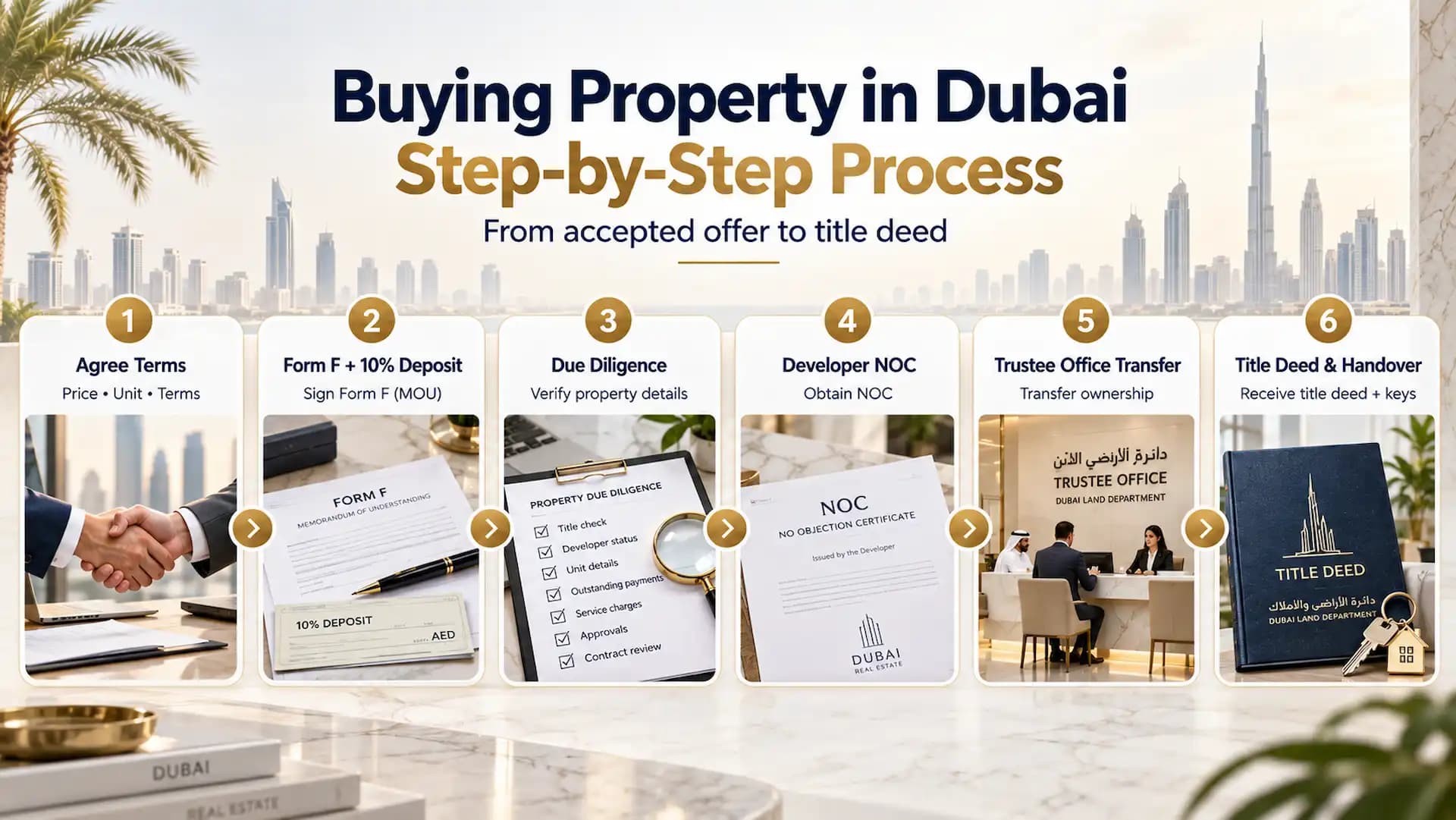
In a reported Dubai case, a buyer who walked away after signing Form F was ordered to pay AED 1.54 million. Not the deposit. The deposit plus the seller’s broader losses from the failed sale.
That judgment is unusual in scale but not in principle. Form F is the sale contract, not a step towards one, and the assumption that you can sign now and reconsider later is the most expensive misunderstanding in the Dubai secondary market.
It’s also more restrictive than most buyers realise. The moment both parties approve it, the DLD system locks the property, and that lock cannot be released by one side deciding they’ve changed their mind.
This guide covers what the document contains, the six compliance rules the DLD now embeds in every Contract F, the two clauses that matter if you’re buying with a mortgage, and what actually happens when a deal falls apart.
What Form F is
Form F is the Dubai Land Department’s unified sale and purchase contract for secondary market property. You’ll also see it called Contract F, the Unified Sale Contract, or simply the MOU. It became mandatory on 1 May 2014, when the DLD replaced the handwritten MOUs the market had been running on. The problem it solved was straightforward: different agents used different templates, and when deals went wrong, disputes turned on whose wording applied. Two consequences follow from it being a government document. Anything agreed outside the official forms carries very little weight, so a side letter with the seller is not a reliable substitute for a properly drafted clause. And because it’s generated inside DLD systems, it connects directly to everything downstream, including the property reservation described below and registration at the trustee centre. Form F applies to resales only. Buying off-plan directly from a developer uses a Sale and Purchase Agreement instead, which operates under a different legal regime.The forms around it
Form F rarely appears alone. Understanding the chain explains why some terms are fixed before you ever see the contract.Form A: seller and their broker
Authorises a brokerage to market the property, sets the asking price and defines the seller’s commission. Maximum validity 90 days, renewable. No agent can legally advertise a Dubai property without one. A seller may hold up to three Form As simultaneously, provided each is non-exclusive. Sign an exclusive Form A and the property cannot be listed elsewhere for the duration.Form B: buyer and their broker
The mirror image, appointing an agent to search and negotiate for you. Read the exclusivity terms carefully, because some versions leave you owing commission even if you find a property independently during the term.Form I and Form U
Form I governs commission splits when two brokerages collaborate, one on each side. Form U is the only legally recognised way to terminate a broker agreement. Ending the relationship by simply not replying does not work and can leave a live commission claim behind you.How Form F is generated
Brokers create Form F by linking Form A and Form B inside the Dubai Brokers system. Where a buyer is unrepresented, it can proceed on Form A alone. You cannot draft one yourself. Form F must be generated through the Dubai REST app or at an authorised Real Estate Services Trustee Centre by a RERA-certified agent. A document that resembles a Form F but came from anywhere else is not one, and the DLD will not register a transfer against it.The six compliance rules now embedded in Contract F
The DLD has added a compliance section to the Unified Contract F setting out six rules that apply to every transaction running through the system. Most buyers never read them, and several run directly counter to what people assume.1. Both approvals lock the property
Once buyer and seller approve the contract through the DLD’s electronic system, the property is automatically reserved. The listing is blocked from being sold again or booked under another contract. This protects you from a seller entertaining better offers behind your back. It also means the sale is formally in motion from that moment, and cannot be undone unilaterally.2. The lock lifts only on expiry or formal cancellation
The system releases the reservation when the contract lapses through time or is cancelled through proper procedure. Until one of those happens, the property stays locked regardless of what either party now wants.3. Cancellation requires mutual consent
Unilateral cancellation is not permitted. To cancel, both parties must agree, instruct the broker to submit a cancellation request through the DLD system, and approve it digitally. If either side refuses, the contract remains binding and withdrawal triggers the compensation clause. This is the rule people most often get wrong: walking away is not cancelling. It is defaulting, which is a materially worse position.4. Amicable settlement first, Dubai Courts after
Where a party wants out or a dispute arises, the expected first step is a written agreement between the parties. Failing that, the matter escalates to the Dubai Courts, which hold sole jurisdiction over binding rulings on contractual disputes. The DLD operates an Amicable Settlement Centre that mediates disputes in registered property transactions at no charge, with direct access to the DLD’s property database. There’s also a Contractual Dispute Inquiry e-service that issues a written clarification of the regulatory position, which is a sensible first move before anyone instructs lawyers. Worth knowing: contractual property disputes go to the DLD and the Dubai Courts, not the Rental Disputes Centre, which handles landlord and tenant matters only.5. The broker must hold deposit cheques during a dispute
Where a dispute arises, the broker is obliged to retain the deposit cheque and may not release it to either party without written consent from both, or a court order. Brokers sometimes come under pressure from whichever side feels wronged. They are not permitted to act on that pressure, and a buyer or seller pushing for release is asking the agent to breach a regulatory obligation.6. RERA regulates, it does not adjudicate
RERA supervises the market but has no judicial authority to resolve contract disputes. If both parties agree, they can submit a request through Trakheesi for RERA to help initiate an amicable resolution, and if accepted, both are invited to a mediation session. That process is voluntary and non-binding. Expecting RERA to rule in your favour misunderstands what it does.What’s inside the document
Property and parties
Full property details including the DLD registration number, alongside identification for both sides. Where a party is a company, an authorised signatory must sign with supporting corporate documents. Check the details against the title deed rather than the listing. Unit number, plot number, area and parking allocation should all match exactly, and parking in particular is a recurring source of post-sale argument.Price, deposit and payment terms
The sale price, the deposit, and how the balance is paid. The price recorded here is the price the DLD sees, which drives the 4% transfer fee.Commission
What each party pays its agent, when it becomes payable, and whether anything is due if the deal is cancelled. That last point is worth confirming rather than discovering later.Obligations and dates
The target transfer date, commonly 30 to 60 days out, plus who does what. Who applies for the developer’s NOC and pays for it. Who settles service charge arrears. Whether the property transfers vacant or tenanted. If there’s a tenant, the contract needs to address the rent position, whether an eviction notice is already in motion, and whether you’re taking on the existing lease. Notices already served transfer with the property.Default provisions
The most consequential clauses in the document, and the ones worth reading properly before you sign rather than after something goes wrong.The 10% deposit
How it’s paid, and who holds it
Conventionally 10% of the price, usually by manager’s cheque rather than personal cheque or cash, since a manager’s cheque carries the issuing bank’s guarantee. It’s normally held by the agent or a trustee centre, not the seller. Some transactions now use a DLD-linked digital escrow where the funds are frozen in the buyer’s own account and released only on transfer or default, which is worth asking about if you’re buying from overseas.When it’s refundable, and when it isn’t
The deposit is not a refundable booking fee. It is not returned because you changed your mind, found something you preferred, or ran into financing difficulty. It is generally recoverable where the seller defaults, or where a written condition in the contract fails. Everything turns on whether your Form F contains the right conditions, which brings us to the part that matters most if you’re borrowing.Two clauses that matter if you’re buying with a mortgage
These are additional terms, permitted so long as they don’t conflict with the standard clauses. Form F doesn’t prompt for them, so they only appear if someone asks.The subject-to-finance clause
This makes your obligation to complete conditional on actually securing loan approval. Where it exists and is properly worded, a rejected mortgage application triggers a refund rather than forfeiture, because the contract fails through no fault of yours. Without it, a bank declining your application is treated as your failure to perform. The rejection being entirely outside your control makes no difference. A well-drafted version addresses the approval deadline, the valuation, the final offer letter, what the bank requires, and explicitly states what happens to the deposit if finance fails. Vague wording such as “subject to final confirmation” is close to useless unless it defines what confirmation means and who provides it. Since pre-approval is conditional and can still fall over at final approval, this clause is doing real work. Our guide to mortgage pre-approval explains where that gap sits, and how long mortgage approval takes is worth reading before you agree to any deadline.The valuation clause, and the tolerance trap
Your bank lends against the lower of purchase price and valuation. A shortfall means funding the difference in cash on top of your deposit. So the clause should state that the valuation must come in at not less than the purchase price. Here’s the trap: brokers and sellers sometimes push for a tolerance of 5% or 10% below price. Accept that and you’re contractually bound to complete even when the valuation lands under, covering the gap yourself. On a AED 2 million purchase, a 5% tolerance is AED 100,000 of exposure you’ve agreed to in a clause that looked like a concession. If you’re putting down the minimum deposit, a tolerance clause can make the transaction unaffordable at exactly the point you’re committed to it.What happens when a deal collapses
If the buyer defaults
Default covers more than walking away. It includes failing to pay the balance, failing to obtain mortgage approval within the agreed timeline where no protective clause exists, failing to attend the transfer appointment, failing to produce documents, and attempting to cancel without a contractual basis. The seller is generally entitled to retain the deposit as liquidated damages, and may pursue further losses where the property later sells for less or the delay caused quantifiable harm. The AED 1.54 million judgment mentioned at the top arose exactly this way. One thing that does not work: going quiet. Ignoring the process leaves the contract in force while you stop performing, which is the textbook definition of default. Dubai courts have also been unreceptive to force majeure arguments in property matters, on the reasoning that an obligation to pay money is rarely rendered impossible by external events.If the seller defaults
Refusing to transfer, failing to clear their mortgage, failing to obtain the NOC, or withdrawing. You’re generally entitled to your deposit back, and many Form F agreements additionally require the seller to pay compensation equal to the deposit on top. Sellers withdraw more often than buyers expect, usually because prices moved after terms were agreed.The routes out
Mutual written cancellation processed through the DLD system is the fastest and cheapest. The Amicable Settlement Centre is free and comes next. RERA mediation via Trakheesi is available if both parties agree, though it binds nobody. Dubai Courts are the end of the road, and they take months.Mistakes that turn into disputes
- Understating the price to reduce the DLD fee. The 4% saving is trivial against the exposure, it misrepresents the transaction to a government authority, and it leaves you holding a contract that doesn’t reflect what you paid.
- Signing without a finance clause when you’re borrowing. The single most valuable protection available to a financed buyer, and the most commonly omitted.
- Accepting a valuation tolerance. See above.
- Relying on a side agreement. If it matters, it belongs in Form F.
- Not asking whether the seller has a mortgage. It adds one to two weeks and should shape the deadline you agree.
- Not asking about service charge arrears. They block the NOC, and the NOC blocks everything.
- Agreeing a fixed calendar deadline. Tie completion to a trigger, such as a set number of working days after NOC issuance, so normal slippage doesn’t put you in breach.
- Assuming you can cancel later. You can’t, not alone.