NOC stands for No Objection Certificate. In UAE property, it’s the document a developer issues confirming it has no objection to a unit being sold — and the Dubai Land Department will not register a transfer without it.
It’s also a term used for several other things in the UAE, which is why searches for it pull in everything from job changes to car sales. The next section sorts those out. Everything after it is about property.
They share a name and nothing else. This guide covers the first one.
There is no published DLD schedule for this. It’s a developer charge, not a government one, which is why it varies so widely and why you should confirm the figure with the specific developer rather than budgeting an average.
The middle phase is the one that varies. The first phase is the one that actually causes delays, and it’s entirely within the seller’s control.
The NOC types you’ll meet in the UAE
| Type | Issued by | What it’s for |
| Property NOC | The developer | Selling or gifting a property |
| Employment NOC | Your employer | Changing jobs, sponsoring a visa, certain licences |
| Bank NOC | Your bank | Confirming a loan is settled, also called a no-liability letter |
| Landlord NOC | Your landlord | Renovations, subletting, registering a business at the address |
| Vehicle NOC | Your bank or the RTA | Selling a financed car, or transferring between emirates |
What a property NOC actually certifies
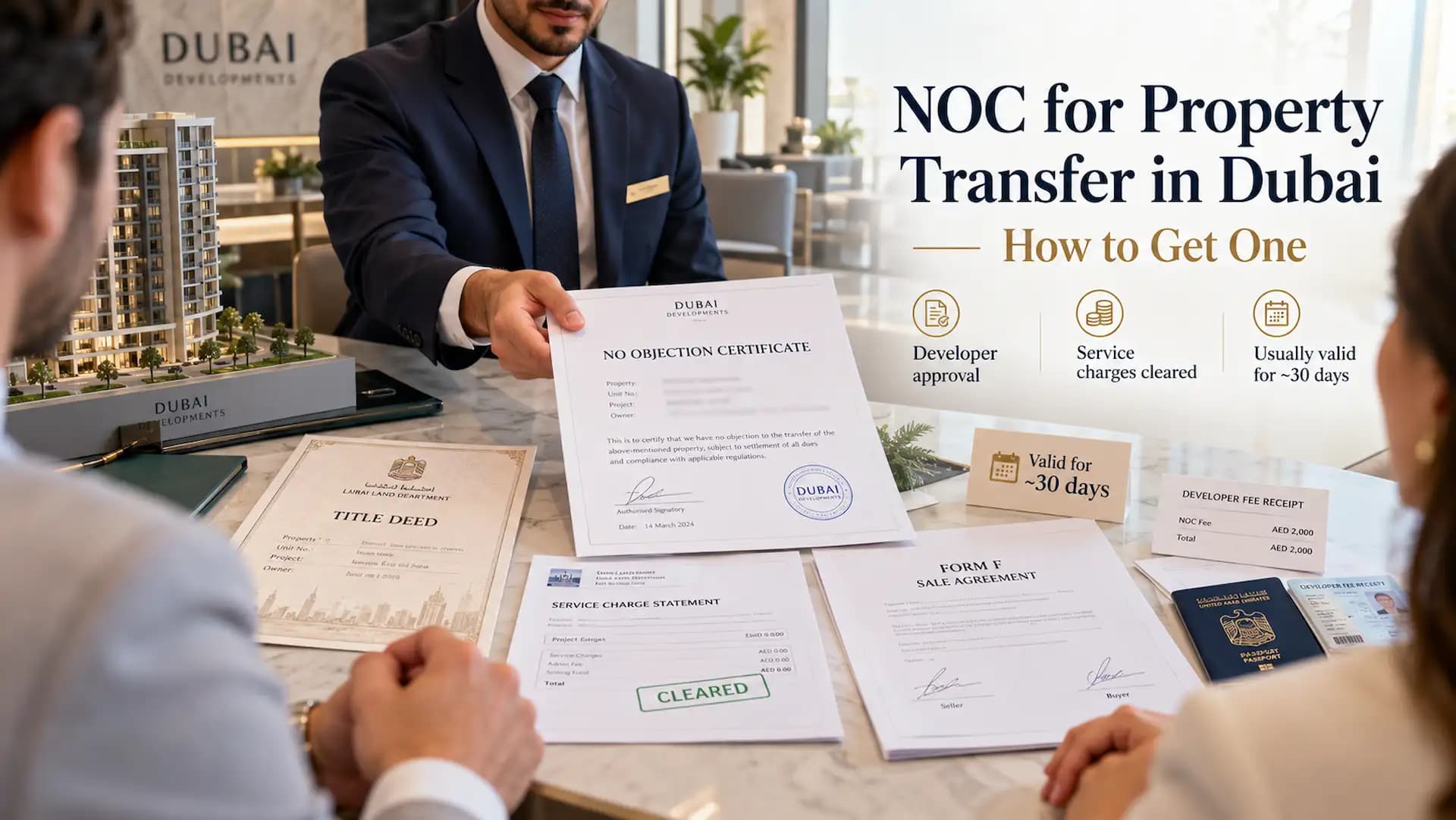
A developer NOC confirms that, on the developer’s records, the unit is clear to transfer. Specifically:- Service charges and maintenance fees are settled — the primary purpose, per the DLD’s own investor guidance
- No outstanding financial obligations to the developer, including instalment balances on off-plan units
- No unapproved modifications or breaches of the community rules
- No developer objection to the sale proceeding
Why nothing moves without one
The NOC is a gate, not a formality. The DLD requires it at the trustee office for any title transfer to register, and without it the transfer cannot complete regardless of what Form F says or what cheques have been prepared. It’s also pre-registration. You secure it in advance and bring it to the appointment — it isn’t something the trustee obtains on the day. The reason the system works this way is buyer protection. A property transferring with five years of unpaid service charges attached would land that liability on the new owner. The NOC requirement closes that exposure before ownership changes hands.What it costs
AED 500 to AED 5,000, sometimes plus VAT, depending entirely on the developer and property type. Concrete examples from the larger developers:| Developer | Typical fee |
| Emaar, apartment | ~AED 1,000 |
| Emaar, villa | ~AED 5,000 |
| Market range across developers | AED 500 – 5,000 |
Who pays
The seller, by convention and because it’s the seller’s account being cleared. Worth flagging: Form F does not always identify who pays developer and clearance charges. If nothing is written, assume it will be argued about later. Put it in the contract.How long it takes
The eNOC has changed this
Historically three to seven working days, sometimes stretching to fifteen with slower developers. Through 2026 most major developers have moved to electronic issuance, and Emaar and Nakheel now commonly issue within 24 to 48 hours where the account is clean and there are no violations. Some offer effectively same-day digital NOCs. If you don’t hold a Dubai REST login, the DLD confirms the eNOC can still be applied for through the management company channel.The realistic three-phase timeline
| Phase | Duration |
| Service charge reconciliation and clearance | 1–5 days |
| NOC processing by the developer | 24 hours to 15 days |
| Validity window to complete the transfer | ~30 days |
Validity: the 30-day trap
An NOC is typically valid for around 30 days. If the DLD transfer slips past that window, the NOC expires and you need a fresh one — which means a new application, a new wait, and a second fee. This matters most when a mortgage is involved. The liability letter, the bank’s final offer, the valuation and the NOC all expire on different clocks, and keeping four documents simultaneously valid is most of the administrative work in a mortgaged Dubai transaction. The practical fix is sequencing. Set the Form F completion deadline as a trigger rather than a fixed date — for example, transfer within fifteen working days of NOC issuance. That survives a slow developer. A bare calendar date doesn’t. Our guide to Form F and what you’re signing covers how to word it.How to get one, step by step
- Request an updated service charge statement from the developer or management company, in writing. Do this before listing, not after finding a buyer.
- Settle any outstanding balance, including late penalties accrued on charges that were paid late.
- Resolve any modification or violation issues flagged against the unit.
- Apply through Dubai REST, or via the management company channel if you don’t have a login.
- Submit the required documents — title deed, Emirates ID and passport copies for both parties, the signed Form F, and the developer’s own application form.
- Pay the NOC fee.
- Receive the e-NOC and check the validity date immediately.
- Book the trustee appointment inside the validity window.
What blocks an NOC
Outstanding service charges
By a wide distance the most common cause, and the most avoidable. Sellers who let charges accumulate across years of ownership routinely face five- and six-figure clearance bills at exactly the wrong moment — after a buyer is committed and a deadline is running. Late penalties compound the problem. Charges that were paid, but paid late, can carry penalties the owner never noticed. Reconciling early, ideally before listing, is the single most effective thing a seller can do to protect the timeline.Unapproved modifications
Underestimated and serious. Alterations made without developer approval — structural changes, external works, anything departing from the approved plans — are a common cause of NOC refusal. Resolving them means either reversing the work or obtaining retrospective approval, and neither happens quickly.Everything else
- Missing or incomplete documents
- An expired Emirates ID or passport
- A court order, legal dispute or DLD caveat on the property
- Discrepancies between the application and the developer’s records