EMI stands for Equated Monthly Instalment, and the word doing the work is equated. It means the payment is level — the same number every month for the whole term — even though what that payment is made of changes completely from the first month to the last.
The term is not native to UAE banking. It came from India and Pakistan, arriving with the expats who make up a large share of this mortgage market, and UAE banks now use it as standard vocabulary. That matters more than it sounds, because if you learned how home loans work in Mumbai or Karachi, several things here work differently in ways that will cost you money if you assume otherwise. Those differences are set out further down.
First, what the number actually is.
Only around month 93 — just under eight years into twenty-five — does more of your EMI go to principal than to interest. Over the full term you pay AED 930,967 of interest on a AED 1.6 million loan: 58 per cent of what you borrowed, paid again.
This shape is why the early years feel like you are getting nowhere. You are not imagining it. The full arithmetic, including the formula and how to build the amortisation table yourself, is in how to calculate mortgage payments in the UAE, or you can skip to the worked figures on our Dubai mortgage calculator.
Read the first two rows again. A 2.5 per cent flat rate costs more than a 3.99 per cent reducing-balance rate — a higher instalment and AED 69,000 more interest, despite a headline number a point and a half lower. If anyone offers you property finance on a flat basis, the rate is not comparable to a mortgage rate and should not be compared to one.
Now look at what each additional five years actually buys you in monthly relief:
The last five years of tenure are poor value. Going from 20 to 25 years saves AED 1,251 a month and costs AED 206,026 in extra interest. Going from 5 to 10 saves AED 13,268 a month. Same five years, ten times the benefit.
The practical reading: take the shortest tenure your cash flow can absorb comfortably, then stop. Twenty-five years is the regulatory maximum, not a default to aim for. If the difference between 20 and 25 years is what makes a purchase work, the purchase is probably too big.
A 50-year-old pays a 40 per cent higher EMI than a 40-year-old on the identical loan. The compensation is AED 402,109 less interest — genuinely better value, but only if the monthly figure fits. This is the main reason buying earlier matters in the UAE, and it is worth modelling before you start viewing.
Moving from 15 to 25 years raises the approvable loan by AED 292,813 on identical income. If an application has been declined for affordability, lengthening the tenure is often the fix — and it is frequently not offered, because the shorter term was the broker’s or banker’s default.
Two ceilings sit above this. The income multiple caps most expats at around seven times annual income — AED 2.52 million here, so it is not the binding constraint in this example — and the age rule may make 25 years unavailable. How the DBR test works in detail is in how debt burden ratio affects your mortgage, and the mortgage eligibility calculator runs both tests together.
The reset difference is the big one. RBI circular RBI/2023-24/55 of 18 August 2023 requires Indian lenders, at the point of every floating-rate reset, to give the borrower the option of “enhancement in EMI or elongation of tenor or for a combination of both options”, plus the right to switch to a fixed rate. UAE borrowers get no such choice. Your bank recalculates the EMI on the remaining balance and remaining term, and that is the number.
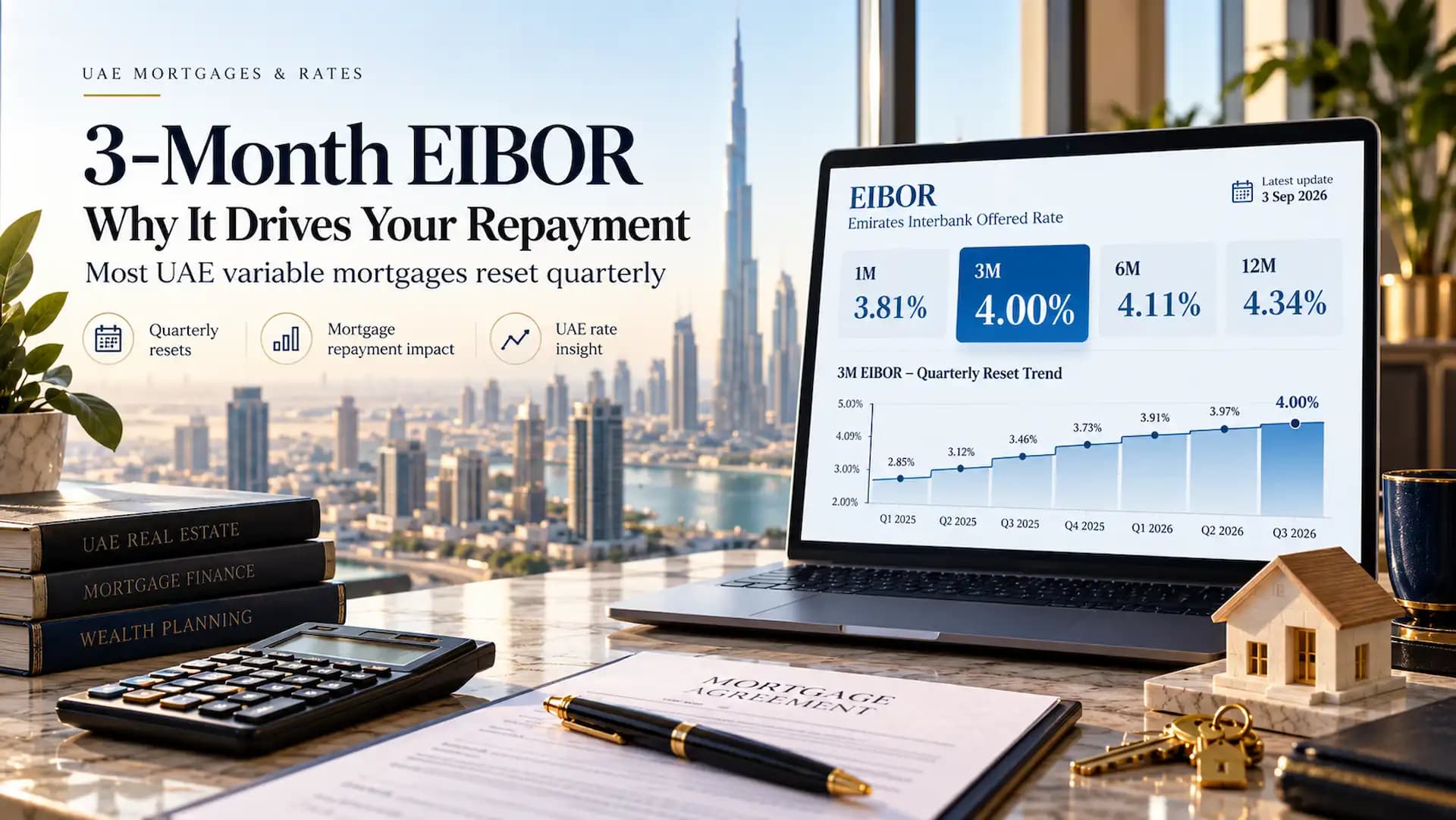
There is a structural reason, not just a commercial one. Suppose you wanted to hold your EMI steady instead. On the AED 1.6 million example, after three years at 3.99 per cent the balance is AED 1,481,023 with 22 years to run. Holding the EMI at AED 8,437 while the rate reverts to 5.89 per cent would push the term well past the 25-year regulatory maximum — so the option is not legally available to the bank. Emirates NBD’s Key Facts Statement states it directly: “the EMI will change depending on the actual EIBOR rate on the review date.” Budget for a moving EMI, because you cannot opt out of one. The mechanics of the benchmark are in EIBOR and how it impacts your mortgage.
Prepayment is not free here. Indian floating-rate home loans to individuals carry no foreclosure or prepayment charge. In the UAE the Central Bank caps the fee at 1 per cent of the outstanding balance or AED 10,000, whichever is less — plus VAT, so 1.05 per cent or AED 10,500. It is a cap rather than a large sum, and above a AED 1 million balance it stops growing, but it is not zero and it needs factoring in. Our guide to the early settlement fee on a UAE mortgage covers how it is charged.
There is no tax shield. In India, the deduction on home loan interest meaningfully lowers the effective cost of an EMI, and many borrowers deliberately run a longer tenure partly for that reason. The UAE levies no personal income tax, so no deduction exists and none of that logic applies. Your EMI costs exactly what it says. Anyone advising you to extend the tenure “for the tax benefit” is applying a different country’s rules.
And the LTV is tighter. Where an Indian borrower might put down 10 per cent on a smaller property, a resident expat here needs 20 per cent on a first home under AED 5 million, 30 per cent above it, and 40 per cent on anything that is not their primary residence. On top of that, roughly 7 to 8 per cent of the price goes on transaction fees that cannot be financed. Full tiers are in UAE mortgage LTV rules for expats and nationals, and the fees in the cost of buying property in Dubai.
Two things to plan around. The payment climbs steadily through construction as more is drawn, so the figure you are quoted at the start is the smallest you will ever pay. And at handover it jumps again — from AED 3,742 to AED 5,553 here, because principal repayment finally begins.
The cost of that comfortable period is real. Twenty-four months of interest-only payments at an average 60 per cent drawn is about AED 53,880 paid with nothing taken off the principal. The construction phase is not cheap financing; it is deferred financing.
Holding the EMI steady saves AED 111,903 more and clears the loan 40 months early. The partial settlement fee on that AED 150,000, at the typical 1.05 per cent of the amount paid, is around AED 1,575 — so either option pays for itself many times over, but one is worth two and a half times the other.
Choose the lower EMI only if you need the monthly cash flow — a tight DBR that is blocking other borrowing, or variable income. Otherwise keep the EMI and take the shorter term, and say so in writing when you make the payment rather than letting the bank default for you.
What is inside your EMI
Take a resident expat buying at AED 2 million with the regulatory 20 per cent deposit — an AED 1.6 million loan at 3.99 per cent over 25 years. The EMI is AED 8,436.56. Every month you pay the same AED 8,437. But in month one, AED 5,320 of it is interest and only AED 3,117 reduces your debt:| Month | Interest portion | Share of EMI that is interest | Balance remaining |
| 1 | AED 5,320 | 63.1% | AED 1,596,883 |
| 12 | AED 5,204 | 61.7% | AED 1,561,910 |
| 60 | AED 4,646 | 55.1% | AED 1,393,428 |
| 120 | AED 3,810 | 45.2% | AED 1,141,329 |
Reducing balance is the only thing worth having
Your EMI is calculated on a reducing balance: interest is charged only on what you still owe, so it falls a little every month. That is standard for UAE mortgages and it is the better of the two conventions by a wide margin. The alternative — a flat rate — charges interest on the original amount for the whole term, no matter how much you have repaid. UAE personal loans are frequently quoted this way, which is why the two keep getting confused. The comparison on the same AED 1.6 million:| Basis | Quoted rate | Monthly instalment | Total interest |
| Reducing balance | 3.99% | AED 8,437 | AED 930,967 |
| Flat | 2.50% | AED 8,667 | AED 1,000,000 |
| Flat | 3.50% | AED 10,000 | AED 1,400,000 |
The tenure effect, and where it stops helping
Tenure is the lever most people reach for when the EMI looks uncomfortable, and it works — but not evenly. Stretching the term has sharply diminishing returns.| Tenure | EMI | Total interest | Interest as % of the loan |
| 5 years | AED 29,459 | AED 167,553 | 10% |
| 10 years | AED 16,192 | AED 342,994 | 21% |
| 15 years | AED 11,827 | AED 528,858 | 33% |
| 20 years | AED 9,687 | AED 724,942 | 45% |
| 25 years | AED 8,437 | AED 930,967 | 58% |
| Extending by five years | EMI falls by |
| 5 → 10 years | AED 13,268 |
| 10 → 15 years | AED 4,365 |
| 15 → 20 years | AED 2,140 |
| 20 → 25 years | AED 1,251 |
Your age may decide this for you
Most UAE lenders require the loan repaid by 65 if you are salaried, or 70 if self-employed. That caps tenure regardless of what you want:| Age at application | Maximum tenure | EMI on AED 1.6m | Total interest |
| 40 or under | 25 years | AED 8,437 | AED 930,967 |
| 45 | 20 years | AED 9,687 | AED 724,942 |
| 50 | 15 years | AED 11,827 | AED 528,858 |
| 55 | 10 years | AED 16,192 | AED 342,994 |
The counterintuitive part: a longer tenure can get you a bigger loan
Here is the mechanism almost nobody explains. Your borrowing limit is set by your debt burden ratio — total monthly commitments must stay inside 50 per cent of gross income — and the mortgage counts at a stressed rate, not the rate you are offered. Because a longer tenure produces a smaller EMI, and a smaller EMI uses less of your DBR, extending the term raises the maximum loan a bank will approve. Take someone earning AED 30,000 a month with AED 3,500 of existing commitments. Their DBR ceiling leaves AED 11,500 a month available. Tested at 7.89 per cent — three-month EIBOR at 4.3891 per cent, plus a 1.50 point margin, plus two points of stress:| Tenure | Maximum loan approved | EMI you would actually pay at 3.99% |
| 10 years | AED 952,441 | AED 9,638 |
| 15 years | AED 1,211,469 | AED 8,955 |
| 20 years | AED 1,386,291 | AED 8,393 |
| 25 years | AED 1,504,282 | AED 7,932 |
If you learned home loans in India
The arithmetic travels. The rules do not. Five differences matter enough to change decisions.| India | UAE | |
| On a rate rise | Borrower chooses: higher EMI, longer tenor, or both | Bank resets the EMI; tenor extension is not available |
| Prepayment charge on a floating loan | None, for individual borrowers | Up to 1% of the balance or AED 10,000, whichever is less |
| Maximum tenure | Up to 30 years | 25 years |
| Maximum LTV | Up to 90% on smaller loans | 80% for a resident expat’s first home under AED 5m |
| Tax relief on interest | Deduction available, subject to regime | None — there is no personal income tax |
Pre-EMI: the EMI before the EMI
If you are buying off-plan, there is a phase before your real EMI starts, and it is the closest thing the UAE has to the Indian concept of pre-EMI. An off-plan mortgage is drawn down in tranches as construction milestones are met, and interest is charged only on what has actually been released. During construction you pay interest alone — Dubai Islamic Bank’s off-plan product, for example, has buyers “pay only the profit component during construction”, with full instalments beginning “at handover or within 24 months, whichever comes first.” On a AED 2 million off-plan unit at the typical 50 per cent off-plan LTV, that is a AED 1 million facility. At around 4.49 per cent:| Amount drawn down | Monthly interest-only payment |
| AED 200,000 | AED 748 |
| AED 400,000 | AED 1,497 |
| AED 600,000 | AED 2,245 |
| AED 800,000 | AED 2,993 |
| AED 1,000,000 | AED 3,742 |
| Full EMI from handover | AED 5,553 |
Prepayment: lower the EMI or shorten the term?
When you make a lump-sum payment, the bank will normally recalculate your EMI downwards and leave the term alone. That is the weaker of the two options and you usually have to ask for the other. Three years into the AED 1.6 million loan, the balance is AED 1,481,023 with 22 years remaining. Put AED 150,000 against it:| Keep the EMI, shorten the term | Keep the term, cut the EMI | |
| EMI | AED 8,437 (unchanged) | AED 7,582 (down AED 854) |
| Remaining term | 18.7 years | 22 years (unchanged) |
| Interest still to pay | AED 558,747 | AED 670,650 |
| Interest saved | AED 187,482 | AED 75,579 |
What your EMI does not include
Two mandatory insurance premiums sit outside the EMI and still leave your account. Life cover runs at roughly 0.0171 per cent per month of the outstanding balance, property cover at about 0.01 per cent plus VAT per month of the property value. On this example: AED 8,437 EMI + AED 274 life + AED 210 property = AED 8,920 a month, about 5.7 per cent above the EMI you were quoted. Neither is optional, and neither appears in any standard EMI calculator. Nor do the transaction fees, which have to be paid in cash on completion day and run to roughly 7 to 8 per cent of the purchase price on top of your deposit. Our guide to mortgage life insurance in the UAE covers how to bring the premiums down. Islamic home finance calculates identically for Ijara-based products — use the profit rate where a calculator asks for an interest rate. Murabaha can differ if the profit is struck as a flat amount rather than on a declining balance, which changes the instalment considerably, so ask which basis applies. The structures are explained in how Islamic mortgages work in the UAE.Checking your EMI in two minutes
- Confirm the rate is reducing balance, and whether it is fixed or introductory. If introductory, get the margin that applies afterwards.
- Work out the first month’s interest: balance × annual rate ÷ 12. It should be comfortably below the EMI.
- Divide total interest by the loan. On a 25-year facility near 4 per cent, expect 55 to 60 per cent. Near 100 per cent means you are being quoted flat.
- Recalculate at today’s reversion rate, then two to four points above it. The stressed figure is what the bank will test.
- Ask what your maximum tenure is given your age, and whether a longer tenure would raise your approval limit.
- Add the two insurance premiums for your real monthly outgoing.