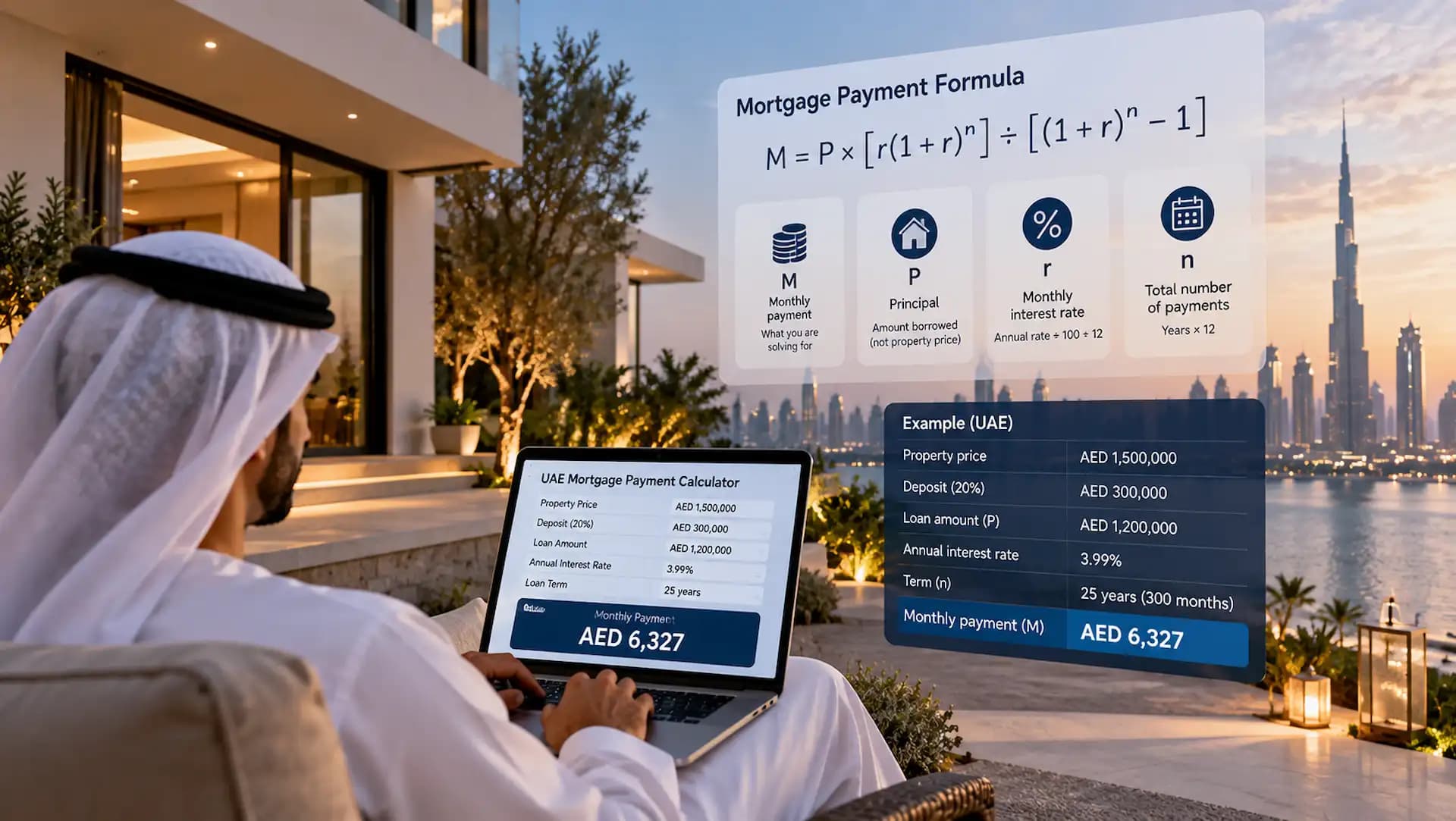
The arithmetic behind every mortgage payment in the country is one line long:
M = P × [ r(1 + r)ⁿ ] ÷ [ (1 + r)ⁿ − 1 ]
That is it. No bank uses anything more exotic for a standard home loan. You can work it on a phone in about thirty seconds.
What goes wrong is almost never the formula. It is the assumptions people feed into it — a rate quoted on a different basis, a term the regulator will not allow, a reset that changes the answer three years in, and two insurance premiums that sit outside the formula entirely. This walks through the maths in dirhams, then through every UAE-specific thing that makes the real number different from the clean one.
Two of these catch people out. P is the loan, not the price — if you are buying at AED 1.5 million with 20 per cent down, P is AED 1,200,000. And r is monthly, not annual: a 3.99 per cent rate is 0.003325 per month, not 0.0399. Putting the annual rate into a monthly formula is the single most common error, and it produces a figure roughly twelve times too large.
A 4 per cent flat rate produces the same instalment as a 6.36 per cent reducing-balance rate. A 3 per cent flat rate is equivalent to 4.98 per cent reducing. So a flat rate that sounds a point cheaper is in fact more than two points more expensive.
Worth knowing even when you are comparing mortgages, because lender literature is not always careful. Emirates NBD’s own Key Facts Statement describes the EMI as “adding the principal loan amount and total interest and dividing this total by the loan period in months” — which is the flat-rate description — before correctly stating that the loan uses “a reducing balance method”. The loan is reducing balance. The plain-English summary is just loose. If a quote ever looks ambiguous, ask for the total interest figure and divide it by the loan: on a genuine reducing-balance 25-year mortgage at around 4 per cent, that ratio lands near 58 per cent, not 100 per cent.
Two things in that table are worth sitting with.
The balance does not halve halfway. It falls below AED 600,000 at month 186 — year 15.5 of 25, not year 12.5. Twelve and a half years in you have paid AED 949,113 and cleared only AED 453,635 of debt. Of everything you had paid by that point, 52 per cent was interest.
This is why overpaying early is worth so much more than overpaying late. A dirham of principal repaid in month 12 avoids interest for 288 remaining months. The same dirham in month 240 avoids it for 60. Identical payment, roughly five times the effect. The fee for doing it is covered in our guide to the early settlement fee on a UAE mortgage.
Two practical notes. Always divide the annual rate by 12 inside the function — this is the same trap as before, and Excel will not warn you. And the result comes back negative, because the function treats money leaving you as a negative cash flow; wrap it in ABS() or put a minus sign in front of the principal if the sign bothers you.
To build the table, put the balance in a column and drag down: =B2*3.99%/12 for interest, =F1-C2 for principal where F1 holds the payment, =B2-D2 for the new balance. Five minutes, and you can then change one cell to see the effect of any rate, term or deposit. The ready-made version is on our Dubai mortgage calculator if you would rather not build it.
And because the rate drives this harder than anything else, the same AED 10,000 a month buys very different amounts depending on where rates sit:
Two percentage points costs you AED 328,000 of buying power on the same budget. Current pricing by lender is on the UAE mortgage rates page.
One caveat: this tells you what a payment buys, not what a bank will lend. That is a separate calculation involving your debt burden ratio and an income multiple, and it is handled by the mortgage eligibility calculator.
If AED 10,811 breaks your 50 per cent debt burden ratio, the application fails even though you can comfortably pay AED 6,327. Calculating the stressed figure yourself before you apply is the single most useful thing this formula does for you.
What each symbol means
| Symbol | Meaning | Where to get it |
| M | Monthly payment | What you are solving for |
| P | Principal — the amount borrowed, not the property price | Price minus deposit |
| r | Monthly interest rate as a decimal | Annual rate ÷ 100 ÷ 12 |
| n | Total number of payments | Years × 12 |
Working it through
Take a resident expat buying at AED 1.5 million with the regulatory 20 per cent deposit, at 3.99 per cent over the maximum 25 years. Step 1 — establish the three inputs. P = 1,500,000 − 300,000 = 1,200,000 r = 3.99 ÷ 100 ÷ 12 = 0.003325 n = 25 × 12 = 300 Step 2 — raise (1 + r) to the power of n. (1.003325)³⁰⁰ = 2.70701167 This is the only part you need a calculator for. It is also the number that does all the work: it says that at this rate, money compounds to 2.707 times itself over 300 months. Step 3 — build the numerator. r × (1 + r)ⁿ = 0.003325 × 2.70701167 = 0.009000814 Step 4 — build the denominator. (1 + r)ⁿ − 1 = 2.70701167 − 1 = 1.70701167 Step 5 — divide, then multiply by the loan. 0.009000814 ÷ 1.70701167 = 0.005272848 1,200,000 × 0.005272848 = AED 6,327.42 So the monthly payment is AED 6,327. Over 300 months you repay AED 1,898,225, of which AED 698,225 is interest — 58 per cent of the amount you borrowed, paid again on top.Checking your answer in one step
There is a quick sanity test. The first month’s interest is simply the loan times the monthly rate: 1,200,000 × 0.003325 = AED 3,990.00 If your payment is below that, you have made an error somewhere, because a payment smaller than the first month’s interest would mean the balance grows rather than shrinks. Here the payment is AED 6,327, so AED 3,990 goes to interest and AED 2,337 comes off the principal. Month two’s interest is then charged on AED 1,197,663 rather than AED 1,200,000, which is why the interest portion falls every month.Reducing balance versus flat rate: the expensive confusion
This is the distinction that costs people real money in the UAE, because both conventions are in active use here. Mortgages are quoted on a reducing balance. Many personal loans and some car finance are quoted on a flat rate. The same number means wildly different things. On a flat rate, interest is charged on the original amount for the whole term, regardless of how much you have repaid. Total interest is simply P × rate × years, and the instalment is the total divided by the number of months.| Basis | Quoted rate | Total interest on AED 1.2m over 25y | Monthly payment |
| Reducing balance | 3.99% | AED 698,225 | AED 6,327 |
| Flat | 3.00% | AED 900,000 | AED 7,000 |
| Flat | 4.00% | AED 1,200,000 | AED 8,000 |
Building the amortisation table
The formula gives you one number. The amortisation table shows you what that number is doing, and it is the more useful object. Four columns, and each row follows mechanically from the one above:- Interest = previous balance × r
- Principal = payment − interest
- New balance = previous balance − principal
- Repeat 300 times
| Month | Payment | Interest | Principal | Balance |
| 1 | AED 6,327.42 | AED 3,990.00 | AED 2,337.42 | AED 1,197,662.58 |
| 2 | AED 6,327.42 | AED 3,982.23 | AED 2,345.19 | AED 1,195,317.39 |
| 3 | AED 6,327.42 | AED 3,974.43 | AED 2,352.99 | AED 1,192,964.40 |
| 4 | AED 6,327.42 | AED 3,966.61 | AED 2,360.81 | AED 1,190,603.59 |
| 5 | AED 6,327.42 | AED 3,958.76 | AED 2,368.66 | AED 1,188,234.93 |
| 60 | AED 6,327.42 | AED 3,484.31 | AED 2,843.10 | AED 1,045,070.81 |
| 120 | AED 6,327.42 | AED 2,857.73 | AED 3,469.69 | AED 855,997.05 |
| 180 | AED 6,327.42 | AED 2,093.05 | AED 4,234.37 | AED 625,253.65 |
| 240 | AED 6,327.42 | AED 1,159.84 | AED 5,167.58 | AED 343,657.11 |
| 300 | AED 6,327.42 | AED 20.97 | AED 6,306.45 | AED 0.00 |
Doing it in Excel or Google Sheets
Nobody builds 300 rows by hand twice. Five built-in functions cover everything, and the syntax is identical in both applications.| What you want | Formula |
| Monthly payment | =PMT(3.99%/12, 300, 1200000) |
| Interest in a given month | =IPMT(3.99%/12, 1, 300, 1200000) |
| Principal in a given month | =PPMT(3.99%/12, 1, 300, 1200000) |
| Total interest over a range | =CUMIPMT(3.99%/12, 300, 1200000, 1, 300, 0) |
| Term needed for a given payment | =NPER(3.99%/12, -6327.42, 1200000) |
| Loan a payment supports | =PV(3.99%/12, 300, -6327.42) |
Running it backwards
More often the useful question is the reverse: I can afford this much a month — what does that buy? Rearranged, the formula becomes: P = M × [ 1 − (1 + r)⁻ⁿ ] ÷ r| Affordable monthly payment | Loan supported at 3.99% over 25 years |
| AED 8,000 | AED 1,517,207 |
| AED 10,000 | AED 1,896,508 |
| AED 12,000 | AED 2,275,810 |
| AED 15,000 | AED 2,844,762 |
| Rate | Loan AED 10,000/month supports |
| 3.99% | AED 1,896,508 |
| 5.89% | AED 1,568,396 |
| 7.89% | AED 1,307,970 |
Where UAE mortgages break the clean formula
The formula assumes a fixed rate for the whole term. Almost no UAE mortgage works that way, and four local realities pull the real number away from the calculated one.The variable reset
Your 3.99 per cent is an introductory rate lasting two or three years. After it, the loan reverts to EIBOR plus a contractual margin, and the payment is recalculated from scratch — same formula, but with the balance that is left and the months that remain. After 36 payments at 3.99 per cent the balance is AED 1,110,767 with 264 months to run. At a reversion of three-month EIBOR at 4.3891 per cent plus a 1.50 point margin — 5.89 per cent — the formula gives: AED 7,515.33, up from AED 6,327.42. An increase of AED 1,188 a month, from a rate change you agreed to at the outset. There is a reason the bank resets the payment rather than extending the term. Holding the payment at AED 6,327 at the new rate would take 404 months to clear — 33.7 years from that point, against the 22 years remaining. That breaches the 25-year regulatory maximum, so extending is not available. Emirates NBD’s Key Facts Statement puts it plainly: “the EMI will change depending on the actual EIBOR rate on the review date.” The practical instruction: run the formula twice, once at your introductory rate and once at today’s reversion rate. The second number is the one you need to be able to afford. How the benchmark moves is covered in EIBOR and how it impacts your mortgage, and the trade-off itself in fixed versus variable in the UAE.The stress test
Banks do not assess you on the payment you calculated. They run the same formula at a rate two to four points above the reversion rate and check that the result still fits inside your debt burden ratio.| Rate used | Payment on AED 1.2m over 25 years |
| Reversion, 5.89% | AED 7,651 |
| Stressed, +2 points | AED 9,175 |
| Stressed, +4 points | AED 10,811 |
Interim interest before the first instalment
Interest starts the day the money leaves the bank, not the day your first instalment is due — and those are rarely the same day. Emirates NBD’s Key Facts Statement states that “all interest charges applicable are calculated from the date of loan disbursal. This will also apply in the case of a deferred First Payment Date.” At 3.99 per cent on AED 1.2 million, interest accrues at roughly AED 133 a day on an actual/360 basis. A three-week gap between drawdown and the first due date is about AED 2,800 of interim interest, usually collected separately or added to the first instalment. It is not in the formula, and it is the most common reason a first payment looks wrong.The two premiums outside the formula
Life cover and property cover are conditions of the loan, not optional extras. At typical market rates — 0.0171 per cent per month of the outstanding balance for life, 0.01 per cent plus VAT per month of property value for property — they add about AED 363 a month on this example, taking the real outgoing from AED 6,327 to roughly AED 6,690. Neither belongs in the payment formula, and both leave your account. Our guide to mortgage life insurance in the UAE covers how to bring that figure down.Islamic home finance: ask which basis
For Ijara-based home finance, the arithmetic is identical to the above — enter the profit rate where the formula wants an interest rate and the instalment comes out the same, with the rental reviewable at the contractual reset dates just like a conventional variable rate. Murabaha is where it can diverge. The bank buys the property and sells it to you at cost plus an agreed profit, with the total fixed at the outset — “fixed instalments per sale contract; profit known upfront”. If that profit is struck as a declining-balance rate, the instalment matches the conventional calculation exactly. If it is struck as a flat amount, you are back in flat-rate territory and the numbers are very different: a profit struck at 3.99 per cent flat on AED 1.2 million over 25 years is AED 1,197,000 of profit and an instalment of AED 7,990, against AED 698,225 and AED 6,327 on a reducing basis. So the question to ask is not what the profit rate is, but what it is applied to. The structures themselves are explained in how Islamic mortgages work in the UAE.Why your number and the bank’s differ by a few dirhams
If you calculate AED 6,327.42 and the offer letter says AED 6,329, nothing is wrong. Three mechanical reasons: Day-count basis. Many lenders accrue on an actual/360 basis, charging a daily rate of annual ÷ 360 across the actual number of days in each month. February then carries less interest than January, and the annual total comes out slightly above a clean monthly division. The formula above assumes twelve equal months. Rounding. Banks round the instalment, usually up to the nearest dirham, and absorb the difference in the final payment. Note that the last row of the table is almost never equal to the others. Value dates. If your due date falls on a weekend or public holiday the actual debit shifts, and a few days of accrual move between periods. A gap of a few dirhams is rounding. A gap of a few hundred means you and the bank are using different assumptions — most often a different rate, a different term, or a flat-versus-reducing mismatch. Ask for the amortisation schedule; every UAE lender will produce one, and comparing row one against your own calculation locates the discrepancy immediately.Checking a quote in two minutes
- Confirm the rate is reducing balance, and whether it is fixed or introductory. If introductory, ask for the margin that follows.
- Work the first month’s interest: loan × annual rate ÷ 12. It should be well below the quoted instalment.
- Divide total interest by the loan amount. On a 25-year facility near 4 per cent, expect roughly 55 to 60 per cent. Anything near 100 per cent means you are being quoted flat.
- Re-run the formula at the reversion rate, then again two to four points above it.
- Add the two insurance premiums to get the real monthly outgoing.
- Ask what interim interest will be charged between drawdown and the first due date.