The short answer: 20% of the price if you are a resident expat buying your first home under AED 5 million, and 15% if you are a UAE national. Those figures are set by the Central Bank, not by individual banks, so no lender can go lower for a standard mortgage.
The longer answer is where people get caught out. The minimum changes with the price, the property type and whether you live here. It is calculated on the lower of the price and the bank’s valuation, not on what you agreed to pay. It cannot come from borrowed money. And it is not the full amount you need on completion day, because since February 2025 every fee has to be paid in cash on top.
Non-residents are not a separate category in the regulation; their limits come from bank policy, and in practice most lenders ask non-residents for 35% to 40% down on a ready property, sometimes more, from a smaller panel of banks. What they need on top is covered in Dubai mortgages for non-residents.
Banks decide what counts as a first home, and most start by asking whether you already own property in the UAE. If you do, expect the second-home limits even if you plan to live in the new one. The full rules are in UAE mortgage LTV rules for expats and nationals.
Off-plan buyers rarely pay a 50% deposit in one go in practice, because developers spread payments across the build. More on that below.
AED 100,000 more on the price means AED 530,000 more in deposit — and a smaller loan. If you are looking at homes priced just above AED 5 million, it is worth negotiating hard to bring the price to AED 5 million or below, or asking whether the seller would split out furniture or fittings under a separate agreement. Even a modest price cut can save more than half a million dirhams of deposit.
A valuation 10% under the price turns a 20% deposit into 28%. This happens more often on off-market deals, in fast-rising buildings and when a buyer overpays to win a competitive sale. Ask for the bank’s valuation before your deposit cheque under the Form F becomes non-refundable, or include a clause that lets you withdraw if the valuation falls short. How valuations work and how to challenge one is covered in property valuation for a Dubai mortgage.
The minimum down payment, by buyer
The limits come from Article 3 of the Central Bank’s Regulations Regarding Mortgage Loans, which sets the maximum loan-to-value — the share of the property’s value a bank may lend. Your down payment is whatever is left.| Buyer and property | Maximum loan | Minimum down payment |
| Expat, first home, AED 5 million or less | 80% | 20% |
| Expat, first home, above AED 5 million | 70% | 30% |
| UAE national, first home, AED 5 million or less | 85% | 15% |
| UAE national, first home, above AED 5 million | 75% | 25% |
| Expat, second home or investment property, any price | 60% | 40% |
| UAE national, second home or investment property, any price | 65% | 35% |
| Off-plan property, any buyer | 50% | 50% |
What that looks like in dirhams
| Price | Expat, first home | National, first home | Expat, investment | Off-plan |
| AED 1,000,000 | AED 200,000 | AED 150,000 | AED 400,000 | AED 500,000 |
| AED 1,500,000 | AED 300,000 | AED 225,000 | AED 600,000 | AED 750,000 |
| AED 2,500,000 | AED 500,000 | AED 375,000 | AED 1,000,000 | AED 1,250,000 |
| AED 4,000,000 | AED 800,000 | AED 600,000 | AED 1,600,000 | AED 2,000,000 |
| AED 6,000,000 | AED 1,800,000 | AED 1,500,000 | AED 2,400,000 | AED 3,000,000 |
The AED 5 million cliff
The higher deposit above AED 5 million applies to the whole price, not just the part above the threshold. So the deposit does not rise gradually — it jumps:| Price | Maximum loan | Down payment | Total cash with fees |
| AED 4,900,000 | AED 3,920,000 (80%) | AED 980,000 | AED 1,307,340 |
| AED 5,000,000 | AED 4,000,000 (80%) | AED 1,000,000 | AED 1,333,640 |
| AED 5,100,000 | AED 3,570,000 (70%) | AED 1,530,000 | AED 1,868,665 |
| AED 5,500,000 | AED 3,850,000 (70%) | AED 1,650,000 | AED 2,013,765 |
Your deposit is set by the valuation, not the price
Banks lend against the lower of the purchase price and their own valuation. If the valuer puts the home below what you agreed to pay, the gap comes out of your pocket. On a AED 2 million purchase by a resident expat:| Bank’s valuation | Maximum loan | Down payment you actually need | As a share of the price |
| AED 2,000,000 | AED 1,600,000 | AED 400,000 | 20% |
| AED 1,900,000 | AED 1,520,000 | AED 480,000 | 24% |
| AED 1,800,000 | AED 1,440,000 | AED 560,000 | 28% |
Where your down payment can come from
The same Central Bank regulation, in Article 2(4), is explicit: “The level of down payment required from the borrower should be drawn from the borrower’s own resources and not from other sources of borrowing.” Banks check this as part of their anti-money-laundering and source-of-funds review, usually through three to six months of bank statements.What banks generally accept
- Savings held in your own name, ideally visible in your statements for several months before you apply
- End-of-service gratuity or bonuses, with the employer letter or payslip that shows them
- Proceeds from selling another property or investment, with the sale documents
- Money transferred from abroad, with a clear trail back to its source
- A gift from close family — not borrowing, so not ruled out by Article 2(4), but most banks want a signed letter from the giver confirming it is a gift that does not need repaying, proof of where the giver’s money came from, and the funds sitting in your account before you apply. Ask your bank for its own gift-letter format early.
What banks do not accept
- A personal loan, credit card or overdraft used for the deposit. This is the case Article 2(4) was written for, and it also shows up on your AECB report and counts against your debt burden ratio, shrinking the mortgage you can get.
- Cash without a trail. Large deposits that appear in an account shortly before an application, with no explanation, will hold up or end the process.
- A “loan” from a friend or relative disguised as a gift.
Zero down payment: what is real and what is not
Search “zero down payment property Dubai” and you will find plenty of offers. Almost none of them mean zero. For a mortgage on a ready home, there is no zero-deposit option for expats. The Central Bank minimum applies to every bank. Any offer suggesting otherwise is either financing the deposit some other way — which breaches Article 2(4) — or not a mortgage at all. What the offers usually are:- Off-plan payment plans. Developers spread the price over the construction period, often with 10% to 20% at booking, further payments during the build, and the balance at or after handover. Some advertise “1% a month”. The upfront payment is low, but you still pay the 4% DLD fee when the unit is registered on Oqood at booking — the largest single cost on day one, unless the developer has waived it.
- Post-handover plans. Part of the price is paid in instalments after you move in, directly to the developer. It lowers the cash you need at handover, but the total is often higher than a comparable home sold for cash, so compare the price per square foot.
- Rent-to-own schemes. Part of your rent counts toward the purchase. They exist for a limited number of units and are usually worse value than buying in the normal way.
- “0% down” off-plan launches. These are rare and often from less established developers, with prices that already include the cost of the incentive.
The First-Time Home Buyer Programme
If you are a UAE resident of any nationality, aged 18 or over, and do not currently own freehold residential property in Dubai, the Dubai Land Department’s First-Time Home Buyer Programme can make the deposit and fees easier to manage. It applies to homes under AED 5 million and gives priority access and preferential prices on launches from participating developers, including Emaar, Nakheel, DAMAC and Meraas, and better mortgage rates and fees from five partner banks: Commercial Bank of Dubai, Dubai Islamic Bank, Emirates NBD, Emirates Islamic and Mashreq. Owning property in another emirate does not disqualify you. It does not lower the Central Bank’s minimum deposit. It does allow the DLD registration fee to be paid in interest-free instalments on an eligible credit card, which helps with the cash needed on day one. The programme can be used once: after you buy through it, you cannot use it again.The deposit is not the cash you need
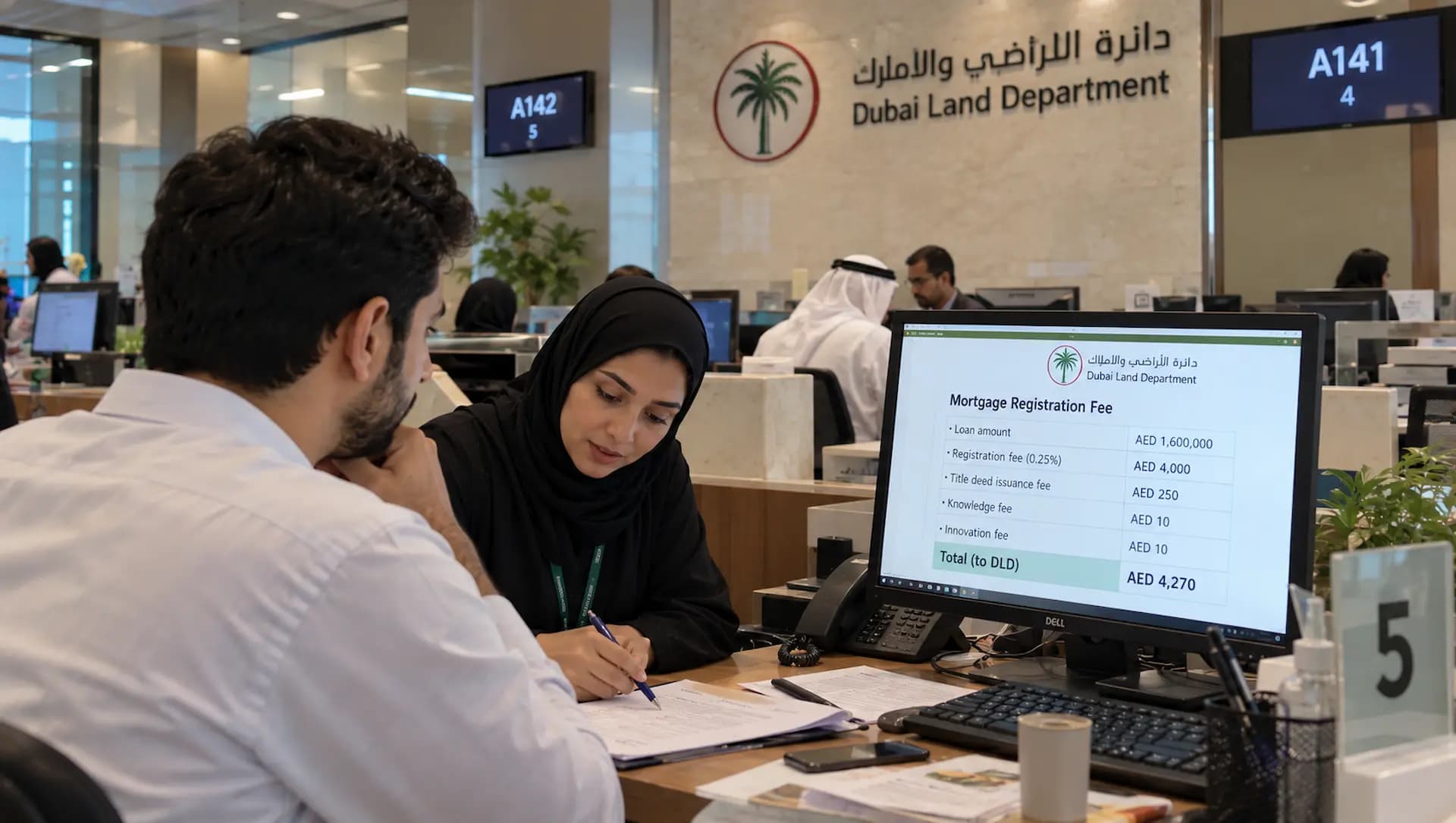
This is the mistake that derails most purchases. The down payment is the minimum share of the price you fund yourself. On top of it you pay, in cash:- the 4% DLD transfer fee
- the agent’s commission, typically 2% plus VAT
- the bank’s processing fee, valuation, mortgage registration and trustee fees
When you actually pay it
You do not hand over the deposit in one transaction:- On signing the Form F, the buyer usually gives a security cheque of 10% of the price, held by the agent or the trustee office. It is not cashed unless you pull out of the deal without a valid reason.
- At transfer, at the trustee office, you pay the rest of your share to the seller by manager’s cheque, together with the fees, while the bank pays its share. The 10% security cheque is returned to you.
- On off-plan, the deposit is paid in instalments to the developer’s escrow account under the payment plan, starting with the booking payment.
Should you put down more than the minimum?
Putting down more lowers the loan, the payment and the interest, and keeps you clear of a valuation shortfall. It also ties up cash in property that is not easy to sell quickly. As a rule:- Keep at least six months of living costs in savings after completion, separate from the deposit and fees.
- Put down more if the extra moves you into a better lending position — for example, a bigger deposit can win a lower rate with some banks.
- Do not empty your savings to buy. If paying the minimum deposit plus fees would leave you with nothing, it may be worth waiting or renting a little longer; the trade-off is set out in rent vs buy in the UAE.