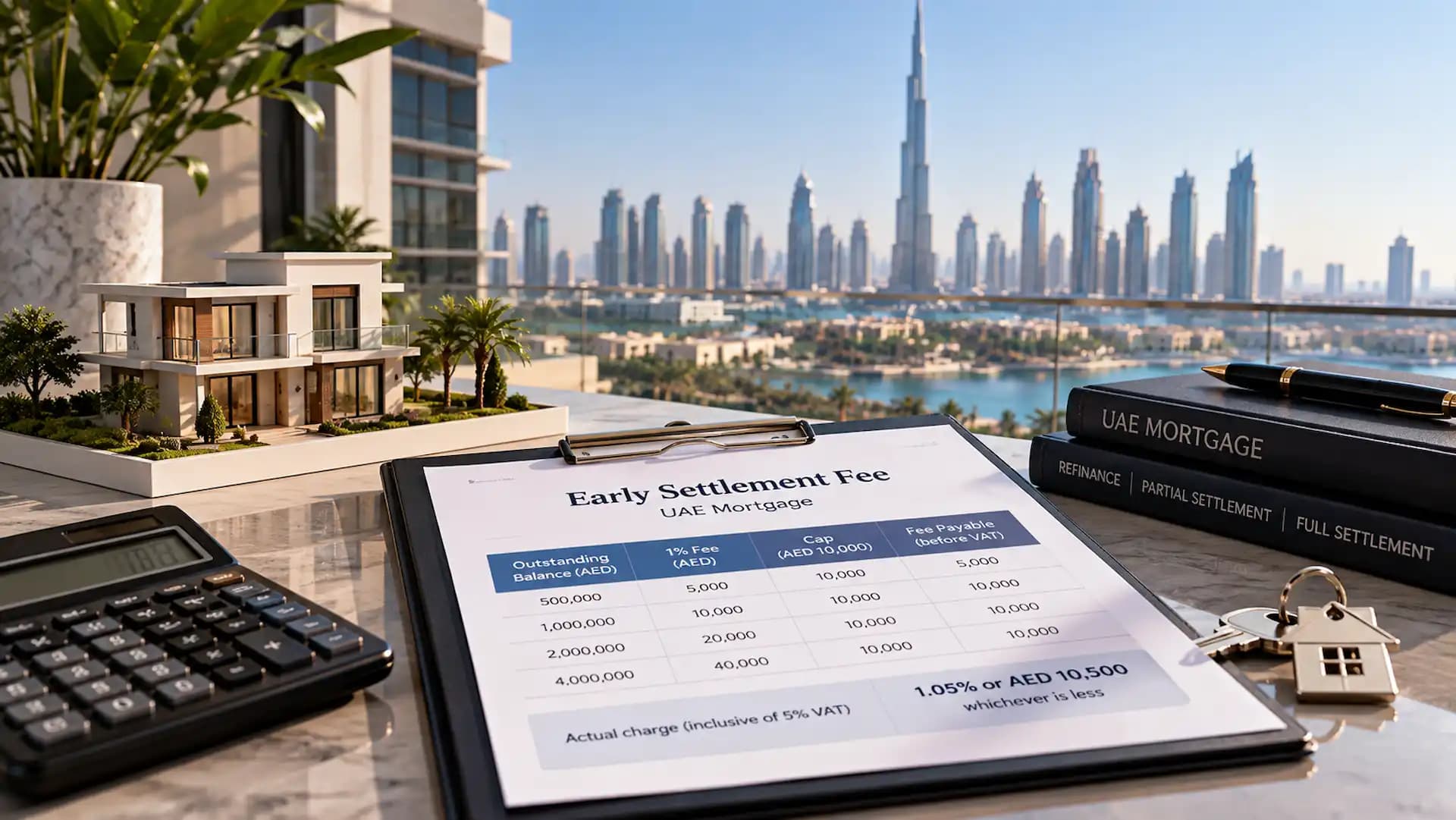
Most people hear “1% early settlement fee” and assume a AED 2.5 million mortgage costs AED 25,000 to clear. It does not. It costs AED 10,500.
The rule is one per cent of the outstanding balance or AED 10,000, whichever is less — and that word is where the whole thing turns. Once your balance passes AED 1 million, the percentage becomes irrelevant and the fee freezes at a flat ten thousand dirhams plus VAT. On a AED 4 million balance you are paying a quarter of one per cent to walk away.
That single feature of the UAE rule changes the arithmetic on nearly every decision that follows: whether to throw a bonus at your mortgage, whether to switch lenders when your fixed period ends, and whether the settlement fee is even the thing you should be worrying about when you do. Usually it isn’t.
Two things about that table are worth slowing down on.
It is a ceiling, not a price. Every figure is a maximum. Your bank may charge less, and several do — Emirates NBD’s published late payment fee is AED 420 against a cap of AED 700. Nothing obliges a lender to charge the full amount, which means it is a legitimate thing to negotiate, particularly if you are a long-standing customer settling voluntarily rather than under pressure.
Every figure is quoted before VAT. The resolution states it plainly: all fees in the appendix are exclusive of UAE VAT. So the real ceiling you will be invoiced is 1.05% or AED 10,500, and that is exactly how the banks write it. Emirates NBD’s Key Facts Statement for its home loan lists the early settlement fee as “1.05% of outstanding principal amount or AED 10,500 whichever is lower (inclusive of VAT)”. If your bank quotes 1.05% and you were expecting 1%, nobody is overcharging you — you are seeing the same number with the five per cent added.
The practical reading: if you hold a large mortgage, the exit cost is close to trivial and should almost never be the reason you stay. If you hold a small one, the percentage bites at full strength and the fee is a real line item against any saving you are chasing. Most UAE mortgage balances sit comfortably above the crossover, which is why the settlement fee is a much smaller obstacle than its reputation suggests.
Both are compliant — the second is simply well inside the ceiling. But a five-fold difference on the same transaction is not a detail, and nothing forces a bank to use the friendlier basis. Before you transfer a single dirham, ask in writing: is the partial settlement fee calculated on my outstanding balance or on the amount I am paying? Then ask whether the fee is charged per transaction, because it is — three separate lump sums in a year can attract three separate fees.
Holding the payment steady and letting the term collapse saves AED 227,000 more than taking the lower instalment. Against a partial settlement fee of AED 2,100, either option is overwhelmingly worth doing — but the default your bank applies may well be the weaker one.
That said, the lower instalment is not the wrong answer for everyone. It buys permanent monthly breathing room, which matters if your income is variable, if your debt burden ratio is tight enough to block other borrowing, or if you expect school fees and a car replacement in the same few years. Know which one you are choosing, and say so in writing when you make the payment.
The monthly payment falls from AED 11,078 to AED 9,082 — AED 1,996 a month. The whole cost of switching is recovered in under 15 months, and across the three-year fixed period you save AED 105,411 in interest against AED 29,745 spent, netting roughly AED 75,700. Where the incoming bank waives its processing fee, which is a common promotion, the payback drops to eleven months.
Note which line is biggest. The DLD mortgage registration charge of 0.25% is levied again on the new mortgage, and the trustee centre fee for a ready property is AED 4,200 regardless of loan size. Together those exceed the early settlement fee. The full mechanics of the transfer, including the liability letter, settlement and re-registration sequence, are covered in the Dubai mortgage buyout and balance transfer guide, and the question of whether to move at all in is switching your UAE mortgage worth it.
The release itself takes ten to fifteen minutes at a trustee centre, or can be done through the bank’s online mortgage system. The wider picture of what a Dubai transaction costs on both sides sits in the cost of buying property in Dubai.
What the regulation actually says
The cap sits in Appendix 2 of Regulation No. 29/2011 Regarding Bank Loans & Other Services Offered to Individual Customers — the Central Bank’s schedule of maximum fees that banks may charge retail customers. Appendix 2 was replaced wholesale by Central Bank Board of Directors’ Resolution No. 96/By Circulation/2019, effective 8 October 2019. Two lines in that schedule matter to a mortgage holder, and they are separate entries:| Home loan fee item | Maximum the bank may charge |
| Early settlement fees | 1% of outstanding balance or AED 10,000, whichever is less |
| Partial settlement charges | 1% of outstanding balance or AED 10,000, whichever is less |
| Late payment fees | AED 700 |
| Issuance of liability letter | AED 85 |
| Clearance letter | AED 95 |
| Issuance of NOC | AED 150 |
| Property swap administration fee | AED 1,320 (valuation included) |
| Non-standard statement or copy of original documents | AED 100 |
The three per cent detour, and why old paperwork lies
Between June 2018 and October 2019 the cap was three per cent, not one. On a AED 1.5 million balance that was the difference between AED 45,000 and AED 10,000 to walk away — a gap wide enough to trap people in facilities they wanted to leave, which is substantially why the Central Bank reversed it. This matters today for one practical reason. Facility letters written in that window, and a surprising amount of bank literature and third-party commentary that was never refreshed, still quote three per cent. If a settlement quote lands in front of you at 3%, or at 1% of the balance with no AED 10,000 ceiling applied, you are looking at a figure the regulation does not permit. Appendix 2 overrides what your contract says, because it sets the maximum a licensed bank may charge regardless of what it drafted into the facility.Where the AED 1 million line falls
Because the cap is “whichever is less”, the effective cost of settling early falls as your mortgage gets bigger. The crossover is a balance of exactly AED 1 million, where one per cent and AED 10,000 are the same number.| Outstanding balance | Fee charged (inc. VAT) | Effective cost |
| AED 400,000 | AED 4,200 | 1.05% |
| AED 600,000 | AED 6,300 | 1.05% |
| AED 1,000,000 | AED 10,500 | 1.05% |
| AED 1,500,000 | AED 10,500 | 0.70% |
| AED 2,500,000 | AED 10,500 | 0.42% |
| AED 4,000,000 | AED 10,500 | 0.26% |
Partial settlement: the basis matters more than the cap
This is the part that trips up almost everyone, and it is where a single question to your relationship manager is worth thousands. Appendix 2 expresses the partial settlement cap the same way as the full one: one per cent of the outstanding balance, or AED 10,000, whichever is less. Read literally, a AED 200,000 lump sum against a AED 1.5 million mortgage would attract AED 10,500 — because 1% of the balance exceeds the cap, so the cap applies. In practice, that is not how the major lenders charge it. Emirates NBD’s Key Facts Statement sets the partial settlement fee at “1.05% of payment amount or AED 10,500 whichever is lower”. On the same AED 200,000 lump sum, that is AED 2,100.| Basis used | Fee on a AED 200,000 lump sum against AED 1.5m |
| 1.05% of outstanding balance, capped | AED 10,500 |
| 1.05% of the payment amount, capped | AED 2,100 |
The free allowance almost nobody mentions
Several lenders let you overpay a defined slice of your balance each year at no charge at all. HSBC UAE publishes this openly: you may overpay up to 25% of your outstanding balance per calendar year, and only amounts beyond that attract a fee. Other banks are reported to run allowances in the 15% to 30% range depending on the product and your segment. Emirates NBD’s published Key Facts Statement contains no such allowance, which tells you this is a product feature rather than a market standard. It is bank-specific, it is sometimes tied to a premium banking tier, and it is almost never volunteered. Find it in your facility letter before you plan a lump sum, because on a AED 1.5 million mortgage a 25% allowance is AED 375,000 a year of fee-free overpayment — more than most people will ever need.What the bank is not allowed to do
Three protections in the Central Bank’s Consumer Protection Standards are worth knowing by number, because quoting them tends to end an argument quickly. Clause 7.1.5.12 — no charging for interest you never owed. “Licensed Financial Institutions are not permitted to charge future unearned interest from the date of full early settlement of the credit facility. In the event of a partial early settlement, the interest must be proportionately adjusted based on the principal remaining.” A settlement quote that includes interest for months after the settlement date is not permissible, and neither is a partial settlement that reduces your balance without reducing the interest you are charged on it. Clause 7.1.1.8 — your cheques come back. When the facility is paid off early, remaining post-dated cheques must be returned to you within seven complete business days. Do not leave a settled mortgage with uncollected security cheques sitting at a bank. Clause 7.1.1.9 — your liability letter in a week. You may request written confirmation of your outstanding liabilities at any time, and the bank must issue it within seven complete business days. In practice most mortgage departments take five to seven working days and the letter stays valid for 30 to 60 days, which is the window you have to complete whatever it was obtained for.Reduce the instalment or shorten the term
When a partial settlement lands, the bank applies it to principal and then asks what you want to happen next — or, more often, doesn’t ask, and simply recalculates the instalment downwards. Those are two very different outcomes and the gap between them is enormous. Take a AED 1.5 million balance with 20 years remaining at 5.89%, and a AED 200,000 lump sum.| Keep the instalment, shorten the term | Keep the term, cut the instalment | |
| Monthly payment | AED 10,651 (unchanged) | AED 9,231 (down AED 1,420) |
| Remaining term | 15 years 7 months | 20 years (unchanged) |
| Total interest paid | AED 688,177 | AED 915,511 |
| Interest saved vs no lump sum | AED 368,181 | AED 140,848 |
Refinancing: the settlement fee is the smallest line on the bill
Here is where the AED 10,500 ceiling gets put in perspective. The early settlement fee is roughly a third of what it costs to move a mortgage to another bank, and people routinely fixate on it while ignoring the larger charges sitting underneath. With the Central Bank’s Base Rate at 3.90% since 17 September 2026 and three-month EIBOR fixing at 4.3891% on 5 October, anyone whose fixed period has rolled off is now paying EIBOR plus a margin of between 1.00% and 1.99% — call it 5.4% to 6.4%. Meanwhile three-year fixed rates in the market start around 3.75% to 3.99%. That spread is the reason to look, and it is wide enough that the fees barely register. Take the same AED 1.5 million balance with 20 years to run, reverting to 6.38% against a new three-year fix at 3.99%:| Switching cost on AED 1.5m | Amount |
| Early settlement fee (capped, inc. VAT) | AED 10,500 |
| DLD mortgage transfer, 0.25% of the new mortgage | AED 3,750 |
| Title deed, knowledge and innovation fees | AED 270 |
| Trustee centre, ready property (inc. VAT) | AED 4,200 |
| Valuation (inc. VAT) | AED 3,150 |
| New bank processing fee at 0.5% + VAT | AED 7,875 |
| Total | AED 29,745 |
When switching does not pay
The arithmetic reverses on small balances and short remaining terms, because the fixed costs — trustee, valuation, title deed — do not shrink with your loan. On a AED 450,000 balance with twelve years left, the same rate improvement cuts the payment from AED 4,480 to AED 3,938, a saving of AED 542 a month. The switching cost is around AED 15,800, because the settlement fee is now the full 1.05% and the trustee fee is unchanged. Payback stretches to roughly 29 months. Still worthwhile if you intend to keep the property, pointless if you might sell inside two and a half years. The rule of thumb that survives contact with real files: a rate improvement of less than about 0.75 percentage points rarely justifies moving, and a remaining term under five years almost never does. Current pricing by lender sits in the UAE mortgage rates page, and whether to lock or float at all is the subject of fixed versus variable in the UAE.Selling the property
Selling triggers a full early settlement, and the fee applies exactly as it would if you had paid the mortgage off from savings. Some lenders waive it on a genuine sale as a goodwill matter; none are obliged to, and it is worth asking before you list rather than at the transfer appointment. The sequence costs more than the settlement fee alone. You will need a liability letter, blocking at a trustee centre to protect the buyer while the mortgage is cleared — budget roughly AED 1,020 to AED 1,545 — and then the release of the mortgage at the Land Department once the bank is paid:| Mortgage release at DLD | Amount |
| Mortgage removal, ordinary mortgage | AED 1,000 |
| Title deed issuance | AED 250 |
| Knowledge and innovation fees | AED 20 |
| Service partner fee + VAT | AED 315 |
| Total | AED 1,585 |
Islamic home finance
Appendix 2 applies to every bank the Central Bank licenses, Islamic institutions included, so the same 1% or AED 10,000 ceiling governs early settlement of a Murabaha or Ijara home finance. The mechanism differs: rather than interest being waived, the unaccrued portion of the deferred profit is rebated, so you settle against the principal outstanding plus profit earned to date. The economic result is the same one Clause 7.1.5.12 requires of a conventional lender — you do not pay for time you did not use. How these structures work day to day is covered in how Islamic mortgages work in the UAE.Before you pay anything
- Request the settlement quote in writing and check it against the cap. Above a AED 1 million balance, anything over AED 10,500 is wrong.
- Ask whether the partial settlement fee is calculated on your outstanding balance or on the amount you are paying. The difference can be five-fold.
- Check your facility letter for a free annual overpayment allowance before planning a lump sum. You may owe nothing at all.
- State in writing whether a partial settlement should shorten the term or reduce the instalment. Do not let the bank default for you.
- Confirm the settlement date on the quote and make sure no interest beyond it is included.
- If you are switching, price the whole stack — DLD transfer, trustee, valuation, new processing fee — not just the exit fee.
- Collect your remaining security cheques. The bank has seven business days.