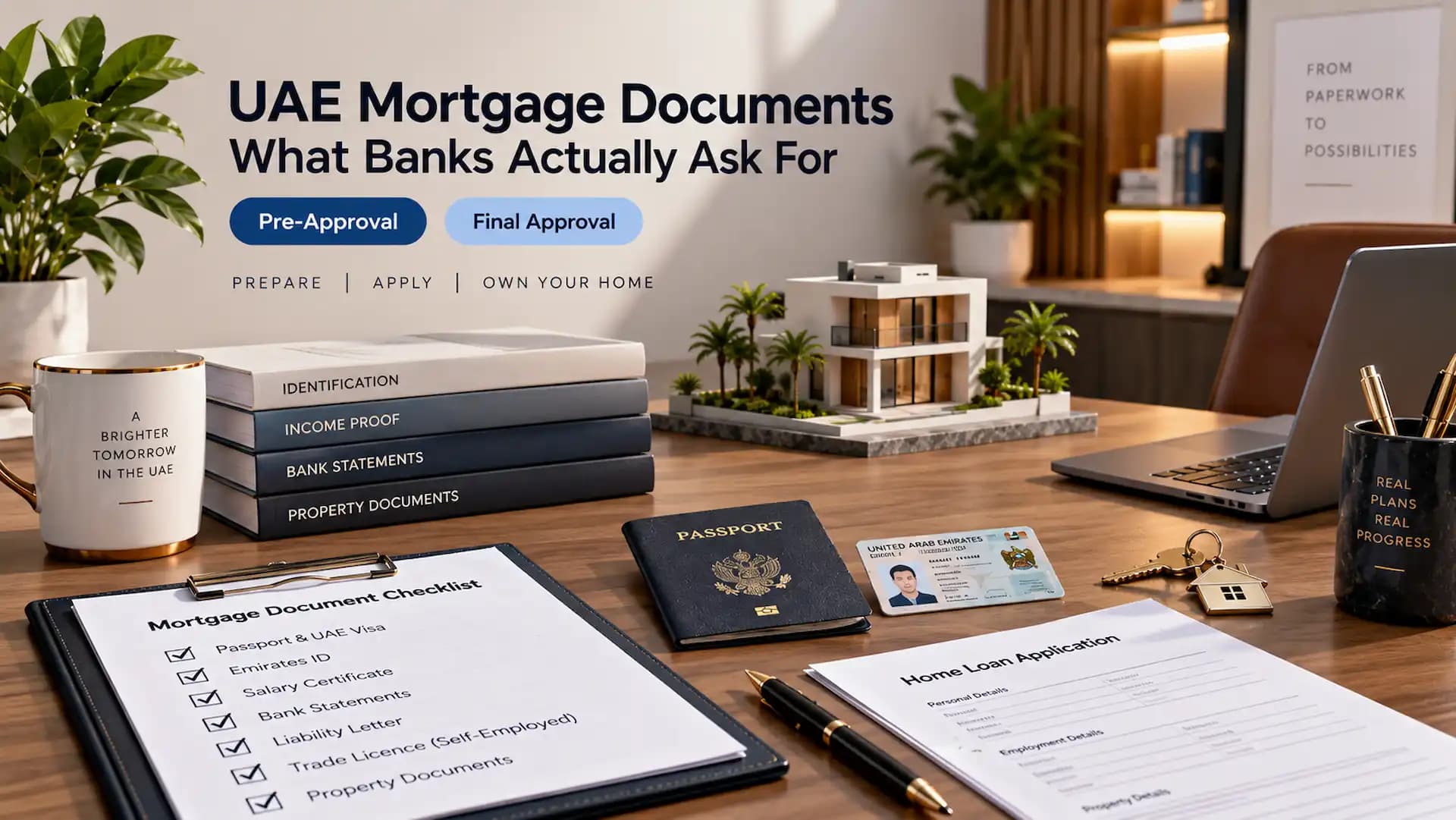
Most mortgage delays in the UAE have nothing to do with whether you can afford the loan. They come from paperwork that was the wrong version, the wrong format, or three days out of date.
The list itself is short and predictable. What trips people up is that each document has to meet a specific standard, several of them expire faster than you’d expect, and a bank will bounce a file over a missing stamp without much interest in the fact that everything else was perfect.
Here’s what you’ll actually be asked for, at both stages of the process, and what each item has to look like to get through first time.
Nearly everyone budgets time for the first stage and forgets the second exists.
Liability letters are the tightest constraint in most transactions. They can take time to issue and then remain valid only briefly, which means requesting one too early is as unhelpful as requesting it too late. Some banks now issue these considerably faster than they once did, so ask about current turnaround rather than assuming the worst.
The practical implication: sequence your document gathering rather than doing it all at once. Start with the items that take longest to obtain and expire slowest, and leave the short-fuse documents until the bank is ready for them.
The short version
You submit documents twice, not once.| Stage | When | What it covers |
| Pre-approval | Before you start viewing | You: identity, income, liabilities |
| Final approval | After your offer is accepted | The property: contract, title, valuation |
Stage one: documents for pre-approval
Identity and residency
- Passport, including the visa page
- Emirates ID, front and back
- For UAE nationals, the Khulasat Al Qaid (family book) instead of a visa page
Proof of income if you’re salaried
- A salary certificate or salary transfer letter, dated within the last 30 days
- Sometimes recent payslips as supporting evidence
Bank statements
Six months of personal bank statements from every transactional account you hold, not just the one your salary lands in. If you hold overseas accounts, expect to provide three to six months of those too. Two details people get wrong. The most recent statement usually has to be no more than 30 days old, so a set you downloaded six weeks ago is already stale. And they need to be complete: full statements with the bank’s stamp or a digital verification watermark, covering every page of the period. Screenshots and partial exports don’t count. Underwriters read these closely. Large unexplained deposits, regular transfers to accounts the bank doesn’t know about, and gambling or crypto activity all raise questions. None of these is automatically fatal, but each needs an explanation you can evidence, and it’s far better to volunteer that upfront.Your existing liabilities
- A list of every loan, card and facility you hold
- Liability letters from your existing lenders, confirming outstanding balances
- Details of any current mortgages, including on overseas property
- Any approved overdraft facilities
If you’re self-employed
You’ll need everything above plus a valid trade licence, memorandum of association, two years of audited financial statements, and twelve months of company bank statements. The audited accounts usually need to be no more than 18 months old, which catches people out at the start of a financial year. Self-employed files carry more scrutiny and more paperwork than this section can properly cover, so it’s worth speaking to a consultant before you start assembling one.If you’re buying from overseas
Non-residents submit a different mix: passport, six months of overseas bank statements, proof of income in your home country, and a credit report from where you live. Since your liabilities don’t appear on a UAE credit bureau report, the evidential burden sits entirely with you, and documents issued abroad may need attestation. Only a handful of UAE banks actively underwrite overseas income, which makes lender choice more consequential here than anywhere else. Our non-resident finance page covers who lends, and there’s more detail in our guide to getting a Dubai mortgage as a non-resident.The salary certificate is where most files fail
Worth understanding properly, because getting it wrong costs you a week and getting it right costs you one clear conversation with HR.A certificate and a transfer letter are not the same document
A salary certificate confirms your employment and salary, and is usually addressed “To Whom It May Concern.” A salary transfer letter is addressed to a specific bank and commits your employer to routing your salary there. It’s what lenders want when a rate depends on salary transfer, and most competitive UAE mortgage rates do. Ask the bank which one it needs before you ask HR for anything. Turning up with a generic certificate when the file requires a transfer letter means starting the request again.What it has to contain
- Company letterhead, with the trade licence number and MoHRE establishment number
- Your full name exactly as it appears on your Emirates ID
- Job title and joining date
- Salary broken into basic and allowances, not a single gross figure
- Issue date, clearly shown
- Signature of someone with actual signing authority
- The company stamp
What gets it rejected
It’s more than 30 days old. Almost universal for mortgages. Time the request so the certificate is fresh when you submit, not when you collect it. If your bank appointment is three weeks out, don’t get the letter today. No stamp, or an illegible one. Banks treat unstamped letters as informal correspondence. Emailed PDFs without a stamp are routinely refused even where they’d pass for a credit card. Signed by someone without authority. A junior HR administrator signing without formally delegated authority isn’t enough. It needs an HR manager, finance manager, GM or equivalent. It contradicts your WPS record. Discrepancies between the certificate and the Wage Protection System data trigger immediate rejection, so the figures have to match what’s actually being paid. Typos. A misspelled name, wrong joining date or incorrect Emirates ID number sends you back to HR.Individual banks have their own quirks
Some lenders want the letter addressed to a named department rather than a generic recipient. Some ask for your IBAN included in the body. Some accept digital certificates for smaller loans but want a physical original above a certain loan size. None of this is published anywhere useful. Ask the bank, or your broker, for its specific format before HR drafts anything — several banks will hand over a template you can pass straight to your employer, which removes the back-and-forth entirely.Stage two: documents once you’ve found a property
Pre-approval assessed you. Final approval assesses the property, and it needs a second set of paperwork.What you provide
- The signed Form F or MOU, original rather than a copy
- For off-plan, the Sale and Purchase Agreement with the developer
- A copy of the title deed
- Proof of your down payment funds
- Refreshed personal documents, if the originals have aged past their validity window
What comes from the seller’s side
- The developer’s No Objection Certificate, confirming no outstanding service charges
- A liability letter from the seller’s bank, if the property still carries a mortgage
- The original title deed, handed over at transfer
Every document has a clock
This is the part almost nobody plans for, and it’s the reason well-prepared files still stall. Different documents expire on different timetables, and they all have to be valid simultaneously on the day the bank makes its decision.| Document | Typical validity |
| Salary certificate | 30 days |
| Bank statements | Latest statement within 30 days |
| Audited financial accounts | Most recent within 18 months |
| Tax assessments, where required | Within 12 months |
| Liability letter from a lender | Short, often days rather than weeks |
| Pre-approval letter | 60–90 days, sometimes 30 |
| Property valuation | Bank-specific, commonly a few months |
| Developer NOC | Bank and developer specific |
| Passport and Emirates ID | Should extend well past the transaction date |
Why files get held up
Stale documents. The most common cause by a wide margin, and entirely avoidable. Incomplete bank statements. Missing pages, a period that doesn’t cover the full six months, or statements from only one of several accounts. Poor scan quality. Blurry images, cut-off edges, faded stamps. If a detail isn’t legible, it doesn’t exist as far as the bank is concerned. Inconsistencies between documents. Name spelled differently on the passport and the salary certificate, a joining date that doesn’t match the visa, an income figure that doesn’t reconcile with the statements. Undeclared liabilities. They appear on the credit report anyway, and their absence from your declaration is what causes the problem. Expired trade licence. For self-employed applicants, an out-of-date licence stops the file where it stands. Most of these come down to submitting a file that was assembled over several weeks and never checked as a set before it went in. Our breakdown of why Dubai mortgages get rejected covers the substantive reasons behind a decline, as distinct from the procedural ones here.How to submit so it doesn’t drag
- Ask for the bank’s own checklist before you start. Requirements differ between lenders in small ways that matter, and working from a generic list guarantees at least one round of corrections.
- Request several originals of the salary certificate at once. Extra wet-stamped copies cost nothing and save a return trip to HR.
- Name your files properly. Passport, Emirates ID, salary certificate, statements by month. An underwriter who can find things moves faster than one who has to open twelve attachments called scan.pdf.
- Check the whole set on the day you submit, not on the day you gathered each piece. Look specifically at issue dates.
- Volunteer explanations for anything unusual in your statements rather than waiting to be asked. A one-line note about a large deposit is a formality; the same deposit queried by an underwriter three weeks in is a delay.