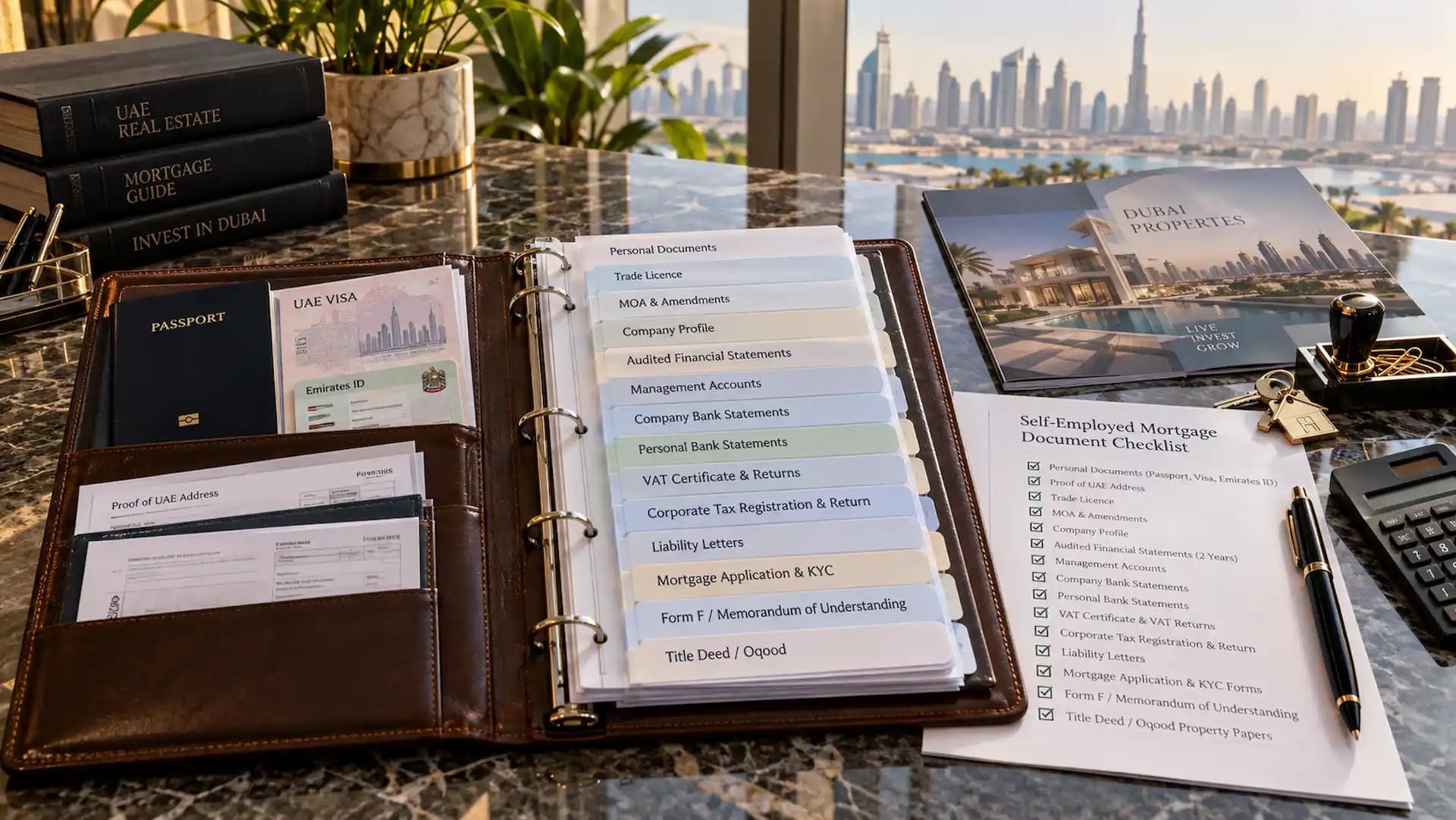
A salaried buyer’s mortgage file fits in an envelope. A self-employed buyer’s file is closer to a folder, and every page in it is checked against the others.
That is not a reason to worry. It is a reason to prepare. Most delays on self-employed applications have nothing to do with how much the business earns. They happen because one document is out of date, unsigned, incomplete or in the wrong format, and the bank stops until it is replaced. Each round trip can cost a week, and on a property with a deadline, a week matters.
This guide sets out the full self-employed document list, what each item must show to be accepted, and when in the process you will need it. It is about the paperwork. How banks then calculate your income from it is explained in self-employed mortgages in Dubai, and the standard list for salaried buyers is in the mortgage documents checklist.
Requirements vary by bank and by your situation, but a file with all of this is complete for almost any lender. The sections below explain what makes each document acceptable.
The full checklist at a glance
| Document | Who issues it | Usually needed |
| Passport, residence visa, Emirates ID | You | Pre-approval |
| Proof of UAE address | Ejari, tenancy contract or DEWA bill | Pre-approval |
| Trade licence, current | Economic department or free zone | Pre-approval |
| MOA and all amendments, or share certificates | Notary, free zone or registry | Pre-approval |
| Company profile | Your company | Pre-approval |
| Two years of audited financial statements | Your auditor | Pre-approval |
| Management accounts for the current year | Your accountant | When the last audit is more than six months old |
| 6 to 12 months of company bank statements | Your bank | Pre-approval |
| 6 to 12 months of personal bank statements | Your bank | Pre-approval |
| VAT certificate and last four returns | Federal Tax Authority | If VAT-registered |
| Corporate tax registration and latest return | Federal Tax Authority | If filed |
| Liability letters for loans to be settled | Your existing lenders | Pre-approval or before final offer |
| Signed application, credit bureau consent and KYC forms | The lender | Pre-approval |
| Memorandum of understanding (Form F) | Buyer, seller and agent | Once you have a property |
| Title deed or Oqood, and seller documents | Seller or developer | Once you have a property |
Your personal documents
Passport, visa and Emirates ID. These need to be valid, and with some time left on them. A visa that expires within a few months of your application can delay a final offer, because the bank will want to see the renewal first. If your company sponsors your visa, the renewal depends on the company’s own paperwork being in order too. Proof of address. Your Ejari-registered tenancy contract, or a recent DEWA bill in your name, is usually enough. If you live in a home you own, the title deed works. Credit report. The bank pulls your Al Etihad Credit Bureau report itself, with your signed consent, but it is worth looking at your own report before you apply, so you see what the bank will see. How to get it is explained in how to check your credit score in the UAE.Your business documents
Trade licence. A clear copy of the current licence, showing your name or the company’s partners, the activities and the expiry date. If the licence expires within the next two to three months, renew it before applying. Banks look closely at how old the licence is, its activities and where it was issued, and those questions are covered in getting a mortgage with a trade licence. MOA and amendments. The memorandum of association shows who owns the company. The bank needs the original MOA and every amendment since, so it can follow the chain of ownership from formation to today. A missing amendment, for example when a partner left two years ago, is one of the most common reasons a file goes back. Free zone companies often hold ownership in share certificates or a register of shareholders instead; provide those. Company profile. A short document on company letterhead covering what the business does, how long it has operated, its main clients or customers, the number of staff and the office address. It does not need to be elaborate. Two pages that answer an underwriter’s obvious questions save a phone call. Supporting company documents. Some lenders also ask for the establishment card, the office lease or Ejari, and, for some structures, a certificate of incorporation or incumbency. Keep them ready even if they are not on the first list.Financial statements
Audited accounts for the last two financial years. This is the document underwriters spend the most time on, and the one most often rejected for format. To be accepted, each year should include:- The auditor’s report, signed and stamped by the audit firm, with the firm’s name and licence visible
- The full set of statements: income statement, balance sheet, cash flow statement and the notes
- Company details that match the licence: the same legal name and licence number
Bank statements
You will need statements for both your company and personal accounts, usually covering six to twelve months. More is better if your income is seasonal. The format matters more than people expect:- Full statements, not screenshots. Send official PDF statements downloaded from online banking or issued by the branch, showing the bank’s name, your account name and number, and every page.
- Every account. If the company has two accounts, send both. An account the bank finds later, through transfers on another statement, looks like something left out.
- Consecutive months. A missing month breaks the average and has to be supplied.
- Stamped where asked. Some lenders ask for statements stamped by the issuing bank, especially for foreign or older accounts. Ask before you send.
- Recent. The latest statement should normally be no more than a month old when you apply.
Tax documents
VAT. If the company is registered, provide the VAT registration certificate and the last four quarterly returns. Banks use them to check that the turnover in your accounts and statements is real, because the returns are filed with the Federal Tax Authority. If your returns, statements and accounts tell different stories, sort that out with your accountant before you apply. Corporate tax. Since corporate tax took effect, more lenders ask for the company’s corporate tax registration and, once filed, its latest return. They carry the same weight as VAT returns: an official record of what the business declared.Liabilities
For every loan or credit card you hold, personally or as guarantor, the bank needs to know the balance, limit and monthly payment. Most of this comes from the credit report. You will need liability letters from your existing lenders if any debt is going to be settled or reduced as part of the mortgage, for example a car loan you plan to clear, or if you are moving an existing mortgage to a new bank. If you have signed personal guarantees for company facilities, list them too, with the facility amounts. How banks treat them is covered in mortgages for business owners in the UAE.Extra documents for particular situations
| Your situation | What else to provide |
| Partner in a company | Your share in the MOA or share register; sometimes partners’ passports and a list of all partners |
| More than one company | Licence, MOA and accounts or statements for each company you own |
| Paying yourself a salary | Salary certificate on company letterhead, usually dated within the last 30 days, plus payroll or Wage Protection System records |
| Recently restructured | The old licence, accounts or statements from the earlier company, to show continuity |
| Company bank account abroad | Statements from that account, stamped where the bank asks |
| Non-resident self-employed | Company registration, shareholder records, accounts and tax returns from your home country, a home-country credit report and proof of overseas address — see Dubai mortgages for non-residents |
| Documents not in English or Arabic | Legal translation; foreign documents may also need attestation |
| Deposit coming from the company | Evidence of the dividend or drawings that moved the money to you |
Documents once you have found a property
A pre-approval is based on your documents alone. When you agree a purchase, the bank needs the property side of the file before it can issue a final offer:- The signed memorandum of understanding (Form F), setting out the price and terms
- A copy of the title deed, or the Oqood registration for an off-plan property, with the developer’s statement of account
- The seller’s passport and ID, and, if the seller has a mortgage, their bank’s liability letter
- Payment of the valuation fee, so the bank’s valuer can inspect the property
Timing: what expires and when
Self-employed files take longer, and documents go stale while you search for a property.- Pre-approvals are usually valid for around 60 days, sometimes 30 or 90. Check the date on your letter.
- Bank statements will need updating if your application runs on for more than a month or two.
- A salary certificate from your own company is usually expected to be recent, often within 30 days.
- Your licence, establishment card and visa must stay valid until the mortgage is registered.
- Before you sign an MOU, check that nothing in your file will expire before the transfer date.
The faults that send files back
From experience, these are the issues that most often stop a self-employed file:- Screenshots or partial statements instead of full official PDFs
- A missing MOA amendment, so ownership does not match the licence
- Unsigned or draft accounts, or a profit and loss statement without the auditor’s report
- A licence or visa expiring during the application
- A company account left off the list, then discovered on another statement
- Unexplained large transfers with no note
- Names that do not match: a trade name on the statements that differs from the licence without the amendment to explain it