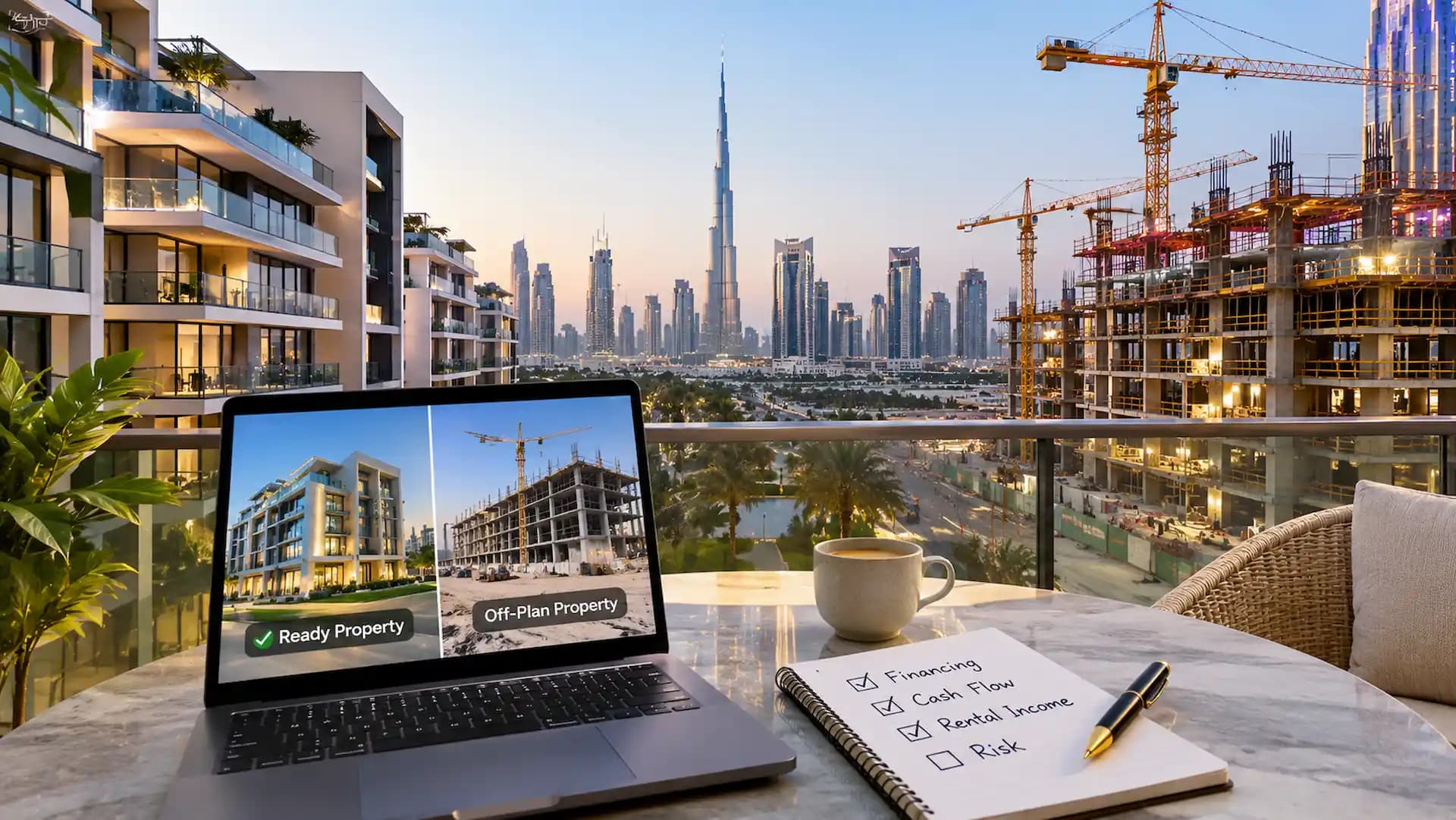
For most off-plan buyers, the hardest moment is not the booking. It is the letter that arrives two or three years later: the building is finished, and the balance is due. Depending on the payment plan, that can be 30%, 40% or even 50% of the price, payable within weeks.
There are three ways to meet it. You can pay in cash, take a mortgage on the newly completed home, or use a post-handover payment plan, where the developer lets you pay part of the price after you move in. Each one changes your monthly costs, your total cost and how easily you can sell or refinance later.
This guide explains the options, works through the numbers on one apartment, and sets out the handover process itself, from the completion notice to the keys.
How off-plan buyers plan the route to a handover mortgage from the day they book is covered in off-plan mortgages in Dubai.
Illustrative figures; rates, fees and plans vary by bank and developer. How the capped fee for settling a mortgage early works is set out in the early settlement fee.
Three things stand out:
What falls due at handover
When construction is finished, the developer issues a completion notice, sometimes called a handover notice, confirming the unit is ready and setting a deadline for the final payment and inspection. Before you get the keys, expect to pay:- The handover instalment on your payment plan, often 30% to 50% of the price; how plans are structured is explained in what off-plan property is
- Service charges, which start from handover whether or not you move in; many developers ask for an amount in advance
- Utility deposits: a DEWA deposit of about AED 2,000 for an apartment or AED 4,000 for a villa, plus any district cooling registration
- Title deed issuance fees, which are small, since the 4% DLD fee was paid when your purchase was registered on Oqood
Option 1: pay in cash
If you have the money, paying the balance in cash is the simplest route. There is no bank assessment, no valuation risk and no monthly payment. The trade-off is liquidity: tying up AED 600,000 or more in one property leaves less for emergencies or other investments. Some buyers pay cash at handover and borrow against the property later, once it is let, as explained in equity release in Dubai.Option 2: a handover mortgage
A handover mortgage is an ordinary home loan taken out at completion to pay the developer’s final instalment. It is the most common route, and for good reason: once the property is complete, ready-property limits apply. An expatriate buying a first home worth up to AED 5 million can borrow up to 80% of the value, and a UAE national up to 85%, compared with 50% during construction. The full limits are in UAE mortgage LTV rules. In practice, you rarely need anywhere near that. If you have paid 60% during construction, the bank only needs to fund the remaining 40%, which leaves plenty of headroom if the valuation comes in a little low.How banks handle it
- Approved projects. Most banks finance completed homes from established developers. Each bank still keeps its own list, so check that yours covers the project.
- Developer–bank tie-ups. Some banks have handover agreements with specific developers or projects. Reported examples in 2026 include Emirates NBD’s arrangements with Sobha Realty and Dubai Holding, a Dubai Islamic Bank handover offer for Jebel Ali Village, and short-term handover lending from Arab Bank. These come and go, so ask your developer which banks it works with.
- The developer’s documents. The bank needs the developer’s statement of account and a no-objection certificate confirming what you have paid and what remains. How developer NOCs work is explained in the NOC for property transfer.
- A valuation of the completed unit. The bank lends on the lower of the price and its valuation, as explained in property valuation for a UAE mortgage.
- Your affordability today. You are assessed on your current income and debts, not those you had when you booked.
- Payment to the developer. The bank pays the developer directly, and its mortgage is registered when your Oqood registration is converted into a title deed.
When to start
Do not wait for the completion notice. Developers usually give a short window to pay, and a mortgage can take four to eight weeks once the bank has everything it needs.| When | What to do |
| 6 to 12 months before the expected handover | Check which banks finance the project, and compare rates |
| 3 to 4 months before | Get a pre-approval, which usually lasts 60 to 90 days |
| When the completion notice arrives | Book the valuation and request the developer’s statement of account and NOC |
| 2 to 4 weeks after | Receive the final offer, sign and let the bank pay the developer |
| At handover | Snag the unit, collect the keys and confirm the title deed shows the bank’s mortgage |
Option 3: a post-handover payment plan
A post-handover payment plan lets you take the keys after paying only part of the price, and pay the rest to the developer in instalments over the following one to five years. Typical structures include:- 60/40: 60% during construction, 40% over two or three years after handover
- 50/50: 50% during construction, 50% over three to five years after handover
- Plans with a smaller payment at handover, such as 10%, and the rest spread out afterwards
What it means for your title deed
Practices vary. Often the title deed is issued at handover with the developer’s interest registered against it until the final instalment is paid, and some developers delay transferring the title until you have paid in full. Your SPA should say which applies. It matters because it affects when you can sell, refinance or mortgage the property. How Oqood turns into a title deed is explained in Oqood registration in Dubai.Living with the plan
- You can usually let the property from handover, and the rent can help with the instalments.
- Selling usually means paying off the developer first, or getting its consent for the buyer to take over the plan.
- Falling behind has consequences set out in the contract, so read the default terms even after you have moved in.
- Other lenders may count the instalments. If you apply for another loan, a bank may treat your remaining developer instalments as a commitment under the debt burden ratio.
The same apartment, three ways
Take a AED 1.6 million apartment on which you have already paid 60%, AED 960,000, during construction. The remaining AED 640,000 is due at handover. Assume it would let for about AED 96,000 a year, or AED 8,000 a month.| Pay in cash | Handover mortgage | Post-handover plan | |
| Paid at handover | AED 640,000 | Bank pays AED 640,000 | AED 160,000 (10%) |
| Afterwards | Nothing | About AED 3,360 a month for 25 years at 3.95% | AED 480,000 over 3 years: about AED 13,330 a month |
| Covered by rent of AED 8,000 a month? | Not applicable | Yes, with room to spare | No: about AED 5,330 a month short |
| Cost of the money | None | About AED 368,000 of interest over 25 years, or less if you repay early | No interest, but often a higher price |
| Extra costs | None | Valuation, 0.25% mortgage registration, trustee and processing fees | Usually none |
| Flexibility | Full | Can be refinanced or settled early, with the fee capped at 1% or AED 10,000 | Usually free to settle early; selling needs the developer’s consent |
- The post-handover plan is the hardest to carry month to month. Spreading AED 480,000 over three years costs nearly four times the monthly payment of a 25-year mortgage on the full balance, and more than the property earns in rent.
- “Interest-free” is not always cheaper. Borrowing AED 480,000 from a bank over three years at 3.95% would cost about AED 29,800 in interest. If the post-handover price is 5% higher than the cash price, that premium on a AED 1.6 million unit is AED 80,000, more than twice as much.
- You can combine them. Many buyers take a post-handover plan and then refinance the remaining balance with a bank once the title deed is issued, turning a short, heavy payment schedule into a long, light one. The developer must release its interest when the bank pays it off, so confirm in writing how that works before you rely on it. The mechanics of moving a balance to a bank are covered in the mortgage buyout guide.
Handover itself: snagging and keys
The handover appointment is your last chance to get defects fixed before you are formally living with them.- Request a snagging inspection as soon as the completion notice arrives. Appointment slots fill quickly.
- Inspect thoroughly, yourself or with a professional snagging company, which typically costs a few thousand dirhams. Test every door, tap, drain, socket, light and the air conditioning, and photograph every problem.
- Submit the snag list in writing. Verbal complaints are hard to enforce.
- Do not sign “accepted as is” while material defects remain, unless the developer agrees a written plan with dates to fix them.
- Bring the right documents: passport, Emirates ID if resident, a copy of your SPA, your snag list and proof of the final payment, or the bank’s confirmation that it has paid.
- Collect keys, access cards and appliance warranties, and set up DEWA and cooling in your name.
What can go wrong, and how to avoid it
- The pre-approval expires before completion. Handover dates slip. Renew or re-apply once the developer confirms the date.
- The valuation comes in low. Paying a larger share during construction gives you a buffer.
- Your circumstances change. A new job, lower income or a new car loan can reduce what a bank will lend. Avoid big financial changes in the six months before handover.
- The developer’s deadline is tight. Late payment can bring penalties under your SPA. Line up the finance before the notice arrives.
- The post-handover instalments outgrow the rent. Model the plan against realistic rent after service charges and empty months.