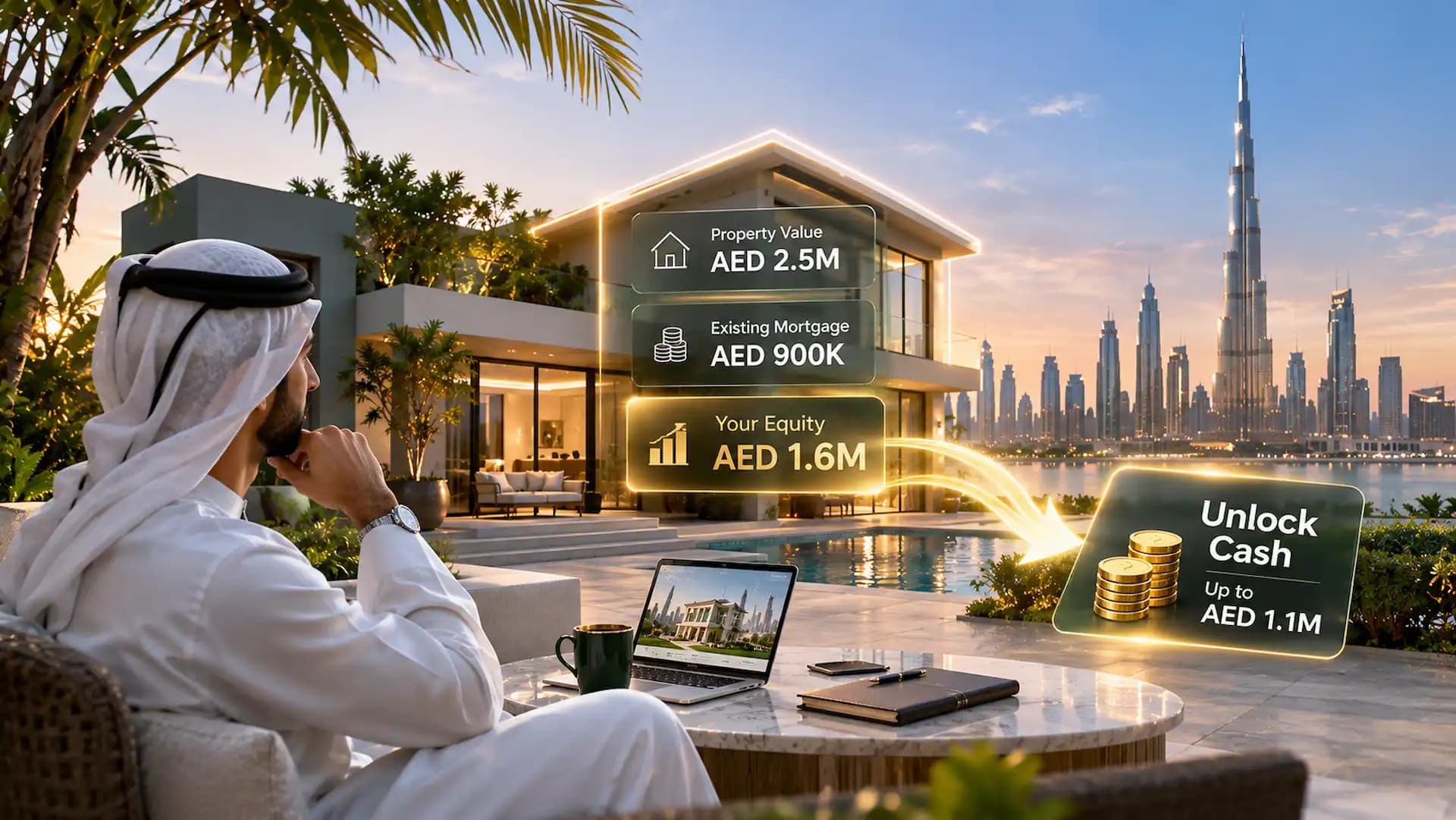
Property owners in Dubai have built up a lot of equity in recent years. Prices rose sharply from 2021, and many people who bought five or six years ago now own homes worth far more than they owe. It is natural to ask whether that value can be put to work: to buy another property, fund a business, renovate or clear expensive debt.
It can. UAE banks lend against property you already own, whether it is mortgage-free or still has a loan on it. But the amount you can raise is usually less than people expect, the bank will want to know what the money is for, and the loan is secured on your home for up to 25 years.
This guide explains what equity release means in the UAE, how much you can borrow, what it costs, what banks ask, and when another route makes more sense.
The limit applies to the total loan after the release, not just the extra cash. So an expatriate with AED 900,000 still owing on a AED 2.5 million home is limited to AED 2 million of total borrowing, not AED 2 million of new cash. The full rules are explained in UAE mortgage LTV rules.
The same equity can release anywhere from AED 600,000 to AED 1.1 million depending on the lender and your profile. If this were an investment property rather than your home, the expatriate ceiling would be 60%, and AED 600,000 would be the most available.
As a rough guide, raising cash on a mortgage-free home costs about AED 6,000 to AED 21,000, a top-up with your own bank is usually the cheapest route, and a cash-out with a new bank costs AED 21,000 to AED 32,000. How to judge whether moving banks pays is set out in UAE mortgage refinance: is switching worth it? The registration charge itself is explained in the mortgage registration fee in Dubai.
Spread over 25 years, the “cheap” option costs almost four times as much in interest as a personal loan, simply because you pay for so much longer. If you are using equity release for a one-off expense, consider a shorter term or overpaying, so the debt does not outlive the thing it paid for. Personal loans in the UAE are limited by Central Bank rules to 48 months and 20 times monthly salary, so for large sums equity release may be the only practical option.
What equity release means in the UAE
Your equity is the part of your property you own outright: its current value minus anything you still owe. Equity release means borrowing against that equity, using the property as security, and receiving the money as cash. If you have read about equity release in the UK, set that picture aside. There, it usually means a lifetime mortgage for older homeowners, where nothing is repaid until the owner dies or moves into care. That product does not exist in the UAE. Here, equity release is an ordinary mortgage: you make monthly repayments over a fixed term, and your income must support them. It comes in two forms:- On a mortgage-free property, often called a loan against property or, in Islamic banking, finance against property. The bank registers a new mortgage on a property that currently has none.
- On a mortgaged property, either a top-up with your current bank, which increases the existing loan, or a cash-out refinance, where a new bank lends more than you owe, pays off your old loan and gives you the difference.
How much you can release
The basic sum is simple: Cash released = new loan − existing mortgage − costs New loan = bank’s valuation × loan-to-value the bank will allow, provided your income can carry the repaymentsThe loan-to-value ceiling
The Central Bank’s mortgage rules set the outer limit, and they depend on who you are and what the property is:| Home up to AED 5 million | Home above AED 5 million | Second or investment property | |
| UAE national | 85% | 75% | 65% |
| Expatriate | 80% | 70% | 60% |
What banks actually offer
Those are ceilings, not promises. Some lenders do advertise equity finance at the maximum: ADIB, for example, publishes finance against property of up to 80% of value, up to AED 15 million for expatriates and AED 30 million for UAE nationals. Many others apply a lower internal limit to cash-out lending, often somewhere between 60% and 75%, and lend less again to non-residents, typically 50% to 60%. Here is what that means for the AED 2.5 million home with AED 900,000 owing:| Bank’s limit | Maximum total loan | Owed today | Gross cash released |
| 80% | AED 2,000,000 | AED 900,000 | AED 1,100,000 |
| 70% | AED 1,750,000 | AED 900,000 | AED 850,000 |
| 60% | AED 1,500,000 | AED 900,000 | AED 600,000 |
Your income has the final say
Even if the property supports a larger loan, your income must cover the repayments on the whole new mortgage, not just the cash you release. Under the Central Bank’s affordability rule, all your monthly debt repayments, with the mortgage tested at a higher stress rate, cannot exceed 50% of your income. On a AED 2 million mortgage over 25 years, stress-tested at 8.37%, the assessed payment is about AED 15,930 a month. With no other debts, that needs an income of roughly AED 31,900 a month. On a AED 1.75 million loan, the figure falls to about AED 27,900. Car loans and credit card limits reduce what you can raise; the calculation is explained in how the debt burden ratio affects your mortgage.The valuation
Everything rests on the bank’s valuation, not your own view of the property’s worth or a listing for a similar flat. After several years of rising prices, 2026 has been more mixed: ValuStrat reported Dubai apartment values about 5% lower in August than a year earlier, and villas slightly down. A valuation AED 100,000 lower than you expected reduces the release by AED 60,000 to AED 80,000. How valuers work is covered in property valuation for a UAE mortgage.What equity release costs
Costs depend on which route you take:| Cost | Mortgage-free property, borrowing AED 1 million | Top-up with your current bank | Cash-out with a new bank, AED 1.75 million loan |
| Early settlement fee | None | None | 1% of AED 900,000 plus VAT: AED 9,450 |
| Valuation | About AED 3,150 | About AED 3,150 | About AED 3,150 |
| DLD mortgage registration, 0.25% | AED 2,500 + AED 270 | 0.25% on the increase or new amount; ask your bank | AED 4,375 + AED 270 |
| Trustee service fee | AED 4,200, where a trustee is used | Usually not needed | AED 4,200 |
| Processing fee | Up to 1%, capped at AED 10,500 including VAT | Up to 1% of the increase | Up to AED 10,500 |
What banks ask about the money
When you buy a home, the purpose of the loan is obvious. When you release equity, it is not, so most lenders ask you to state what the money is for, and some ask for evidence. This is partly about credit risk and partly about anti-money-laundering rules: the bank needs to understand where its money is going. Common purposes, and how banks tend to see them:- Renovation or extension. Usually welcome. Expect to show quotes or a contractor agreement for larger sums.
- Clearing expensive debt. Often accepted, and it can lower your monthly outgoings, but the bank will want to see the debts closed.
- Education, medical costs or family needs. Generally accepted.
- Business capital. Treated more cautiously. Some banks ask for a business plan or accounts; for larger amounts, a business facility may suit better, and our commercial finance team can compare the two.
- Investing in shares or other markets. Some lenders are reluctant to fund this with secured property lending.
- Buying another property. The most common reason, and the one that needs the most care.
Using equity release to buy another property
If you plan to buy the next property outright with the released cash, the main question is affordability. But if you also need a mortgage on the new property, there is a catch. Central Bank rules require a buyer’s down payment to come from their own resources, not from borrowing. A lender financing the second purchase will ask where your deposit came from, and a deposit funded by an equity release loan may not be accepted by every bank. How deposits are assessed is covered in down payments for Dubai property. There is also an affordability squeeze. The repayment on the equity release counts against your income when the second lender assesses you, along with a 60% loan-to-value limit for an expatriate’s second property. Plan both loans together before you release anything.If your property supports a Golden Visa
Adding or increasing a mortgage on a property that underpins a Golden Visa needs care, including the bank’s no-objection letter. How the visa and finance interact is explained in the Golden Visa through property.Is equity release the right way to raise cash?
Equity release is usually the cheapest way to borrow a large sum in the UAE, because the rate is a mortgage rate rather than a personal loan rate. But cheap per year is not the same as cheap overall. Compare two ways of borrowing AED 300,000 to renovate:| Equity release over 25 years at 4.5% | Equity release over 10 years at 4.5% | Personal loan over 4 years at 8% | |
| Monthly payment | AED 1,667 | AED 3,109 | AED 7,324 |
| Total interest | AED 200,200 | AED 73,100 | AED 51,500 |
| Option | Suits | Watch out for |
| Top-up with your current bank | Moderate sums, quickly and cheaply | Your bank’s limit may be lower than others’ |
| Cash-out with a new bank | Larger sums, or a better rate at the same time | Higher switching costs |
| Loan against a mortgage-free property | Owners with no current mortgage | Registration and processing costs |
| Personal loan | Smaller, short-term needs | Higher rate; 48-month and 20-times-salary limits |
| Business facility | Company needs | Assessed on the business, often with personal guarantees |
| Selling | When you do not need the property | Transfer costs and losing the asset |
The risks
- It is secured on your home. If you cannot repay, the bank can enforce its mortgage.
- Rates can rise. After any fixed period, your payment moves with EIBOR on the larger balance.
- Values can fall. A larger loan leaves less margin if prices drop, which can make a future refinance harder.
- It reduces your future borrowing. The bigger repayment counts against your income for any later loan.
- Selling means repaying everything. The whole mortgage must be cleared from the sale proceeds.
Who can release equity
- UAE nationals and expatriate residents with a completed property and a title deed in their name
- Non-residents, with fewer lenders and lower limits; see which UAE banks lend to non-residents
- Joint owners, with every owner’s agreement and signature
- Salaried and self-employed borrowers, subject to the usual income checks and age limits, often 65 for salaried expatriates and up to 70 for nationals and the self-employed at the end of the loan
How the process works
- Get an estimate of value and what each lender will allow. Our refinancing calculator helps with the monthly figures.
- Choose the route: a top-up with your bank, a new lender or a loan on a mortgage-free home.
- Apply and state the purpose of the funds, with any supporting evidence.
- Valuation by the bank’s valuer.
- Final offer, setting out the new loan, rate and conditions.
- Settlement and registration. If a new bank is involved, it pays off your existing loan first, following the steps in the mortgage buyout guide, then the new mortgage is registered with the Land Department.
- Release of funds to your account.