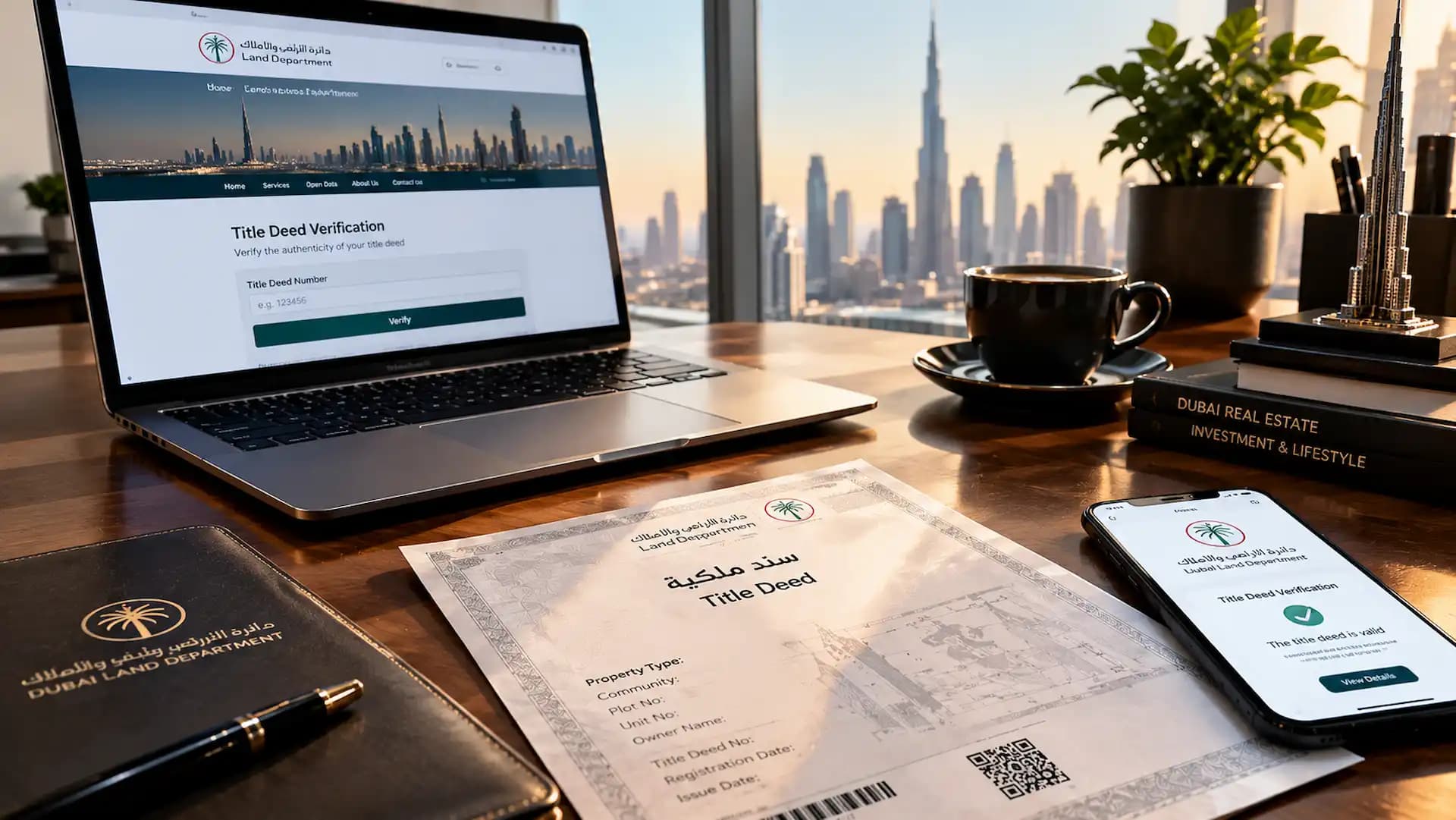
A title deed, or Sanad Milkiyya, is the Dubai Land Department’s official proof that you own a property. It records who owns it, exactly what they own, on what terms, and whether anything is registered against it.
You can verify any Dubai title deed in about two minutes, for free, from anywhere in the world. Most buyers never do, which is remarkable given it’s the single cheapest piece of due diligence available in the entire transaction.
This covers how to verify one, how to read every field, and what to do if yours is lost.
For an off-plan property registered in Oqood, use the Contract Number and Contract Year instead.
Three of those five are reasons to stop and ask questions before you go further. A “mortgaged” result isn’t a problem in itself — roughly a third of Dubai resales involve a mortgaged seller — but it means a liability letter, a blocking procedure and a release have to happen before transfer, which changes your timeline by one to two weeks.
Restrained or blocked means something is actively preventing a clean transfer. Find out what before you sign anything.
A freehold deed lets you sell, gift, mortgage or bequeath the property freely. A usufruct or musataha right is limited by the terms and duration recorded at registration, and reverts to the owner when the period ends.
In Dubai’s designated areas, non-GCC nationals may hold absolute freehold ownership, or a usufruct, musataha or long-term leasehold interest not exceeding 99 years.
The registration fees differ too. A freehold sale and a long-term lease both register at 4% of value, while musataha registers at 1%. Our guide to DLD fees in Dubai sets out the full schedule.
That’s the government charge. For a lost freehold deed, budget on top for a Dubai Police loss report, around AED 70, and a newspaper notice published on three consecutive days, commonly AED 2,500 to AED 3,000.
You’ll need your Emirates ID or passport copy, the police report, the published advertisement and a copy of the original deed if you have one.
Verify a title deed in two minutes
Free, instant, and no login or registration required.What you need
| Field | Where to find it |
| Certificate / title deed number | Below the barcode or QR code on the deed |
| Certificate year | Below the barcode or QR code |
| Property type | Land, Unit or Villa |
| Owner’s name | As printed on the deed |
Through the DLD website
Go to dubailand.gov.ae, open the services list, and select Title Deed Verification or “Verification of Certificate of Title”. Enter the details and submit. No account needed.Through the Dubai REST app
Download Dubai REST, open Title Deed Verification, and either enter the details manually or scan the QR code on the deed with your phone camera. The QR links directly to the DLD’s record.The five statuses you can get back
This is the part most guides miss. Verification doesn’t just return valid or invalid — it returns one of five states:| Status | What it means |
| Valid | Genuine, registered, no restrictions recorded |
| Mortgaged | A lender holds a registered interest in the property |
| Restrained | A legal restriction is registered against it |
| Blocked | The property is blocked from transfer, often pending a settlement |
| Invalid | Not authentic, superseded, or containing errors |
Red flags
- The seller won’t let you verify. Legitimate owners welcome a DLD check; it costs nothing and confirms their position. Reluctance is the clearest warning sign there is.
- Anything doesn’t match exactly. A genuine deed matches the DLD result precisely — down to the spelling of the owner’s name and the exact area. Even small discrepancies indicate either fraud or an administrative error that needs resolving before you proceed.
- No QR code on a recently issued deed. Modern DLD-issued deeds carry one.
- The name on the deed isn’t the person selling. Check for a properly attested power of attorney that specifically authorises the sale of that named property.
Before the deed, check the listing
A 2026 development worth knowing about. Every Dubai real estate advertisement now requires a Madmoun QR code, an electronic verification code issued by RERA confirming the listing permit is genuine. Scanning it validates the advertisement in real time. A listing without a valid Madmoun code is in breach of RERA regulations and carries a meaningfully higher risk of being unverified, duplicated or unauthorised. It’s a thirty-second check before you’ve even reached the title deed stage.How to read a title deed
A Dubai title deed carries more than a dozen fields, each mapped to the DLD’s Real Property Register.Identification
Title deed number — the primary identifier assigned at registration, and what you need for any verification. Certificate year — the year of issuance, required alongside the number. Issuance date — when this particular certificate was produced. Note that a recent date doesn’t mean recent purchase; a deed is reissued on any amendment. QR code — links to the DLD’s digital record.Owner
Owner name or names — individual, joint, or corporate. Deeds can be issued in all three forms. Owner share — usually 100%, but joint ownership percentages are recorded here. Worth checking on anything bought by a couple or a group, because every registered owner must consent to a sale.Property
Community, project, plot, building and unit number — the precise identification. Check all of these against what you’ve actually viewed. Confirming the project name also confirms the development is DLD-registered. Property type — land, villa or unit. Area — in square metres, sometimes with a square foot equivalent. This is the figure to compare against the listing, and discrepancies here are common enough to be worth checking deliberately.Nature of ownership
The field people skim past, and the one that defines what you’re actually buying. It records whether the right is freehold, leasehold, usufruct or musataha — and those are very different things.The four ownership types
| Type | What you own | Duration |
| Freehold | The property and the land beneath it | Indefinite |
| Leasehold | The property; land stays with the freeholder | Up to 99 years |
| Usufruct | The right to use and exploit land owned by another | Up to 99 years |
| Musataha | Usufruct plus the right to build on the land | Up to 50 years |
Spotting a mortgage
Two ways, and it’s worth doing both. The verification status will return mortgaged where a lender holds a registered interest. For more detail, Dubai REST’s Property Verification service shows encumbrances registered against a property. A title deed shows ownership but doesn’t always display every financial obligation in a way that’s obvious on the face of the document, so checking encumbrances separately is the more thorough approach. If the property is mortgaged, that reshapes your transaction. The seller needs a liability letter from their bank, the property gets blocked at the trustee office while the loan is settled, and a release letter is issued before transfer can complete. Add one to two weeks.When you get your title deed
Ready property
Issued on the day, at the registration trustee office, once the transfer is processed. You walk out with it.Off-plan
You receive an Oqood certificate instead — the DLD’s interim ownership record. It converts to a full title deed at handover, with the developer coordinating the conversion. If the 4% was paid at Oqood registration, you don’t pay it again, only the AED 250 certificate fee and map fees. Verify your Oqood is actually issued after you sign the SPA, using the Contract Number and Contract Year.If you have a mortgage
With a conventional loan, the deed is issued in your name and held by the bank until the loan is repaid. With an Islamic facility under an Ijara structure, the bank is recorded as owner and you as lessee, with ownership passing as the facility is paid down. Different paperwork, comparable economics, and worth understanding before transfer day rather than at it. See how Islamic mortgages work in the UAE. Either way, the digital DLD record is authoritative. The paper document is evidence of it, not the thing itself — which is why losing one is far less serious than people assume.Replacing a lost or damaged deed
Processed by the DLD through an authorised Real Estate Registration Trustee Centre.What it costs
| Item | Fee |
| Title deed certificate issuance | AED 250 |
| Map | AED 120 |
| Knowledge fee | AED 10 |
| Innovation fee | AED 10 |
| DLD total | AED 390 |