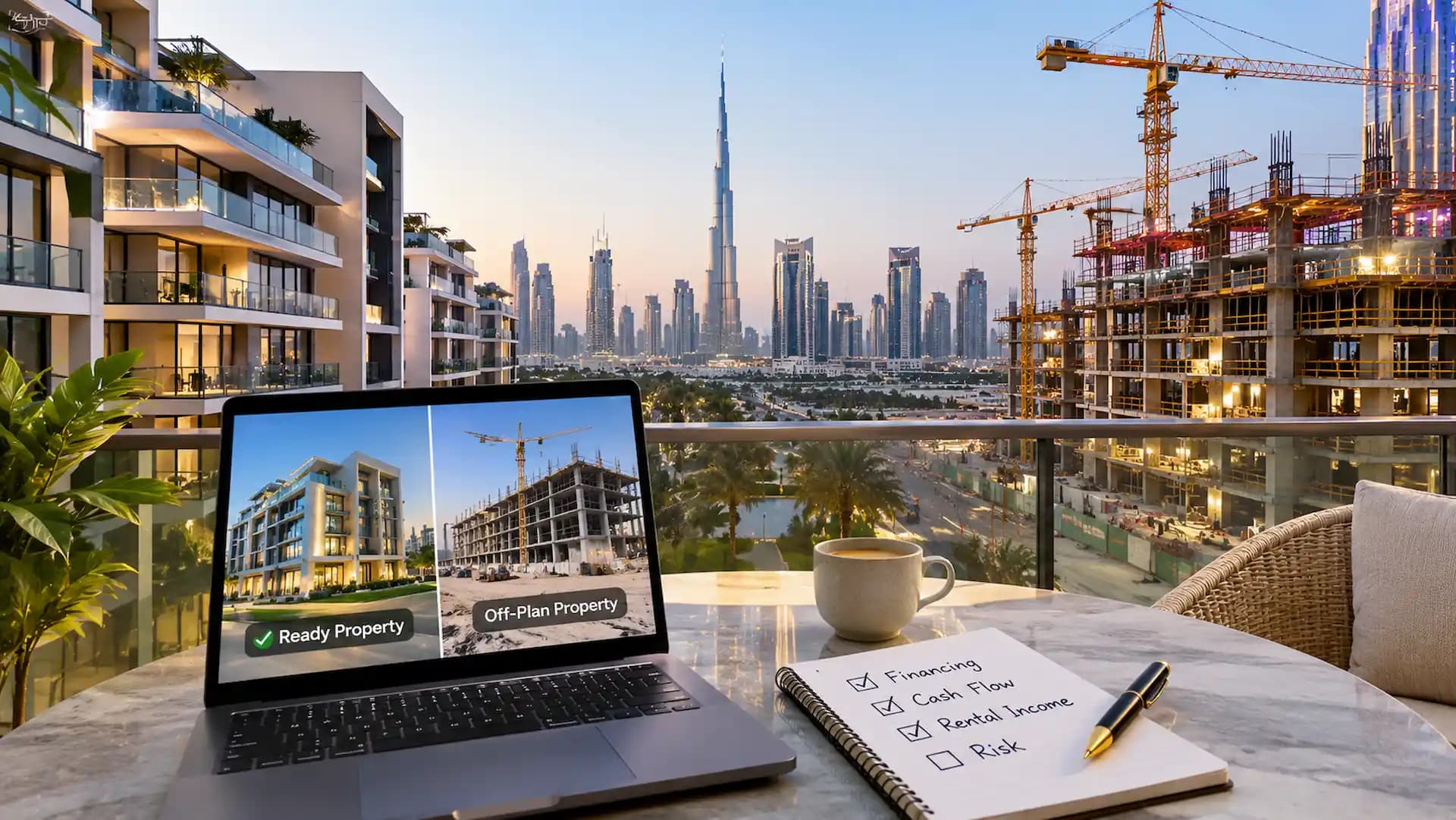
Walk past almost any sales gallery in Dubai and you will see the same offer: a home that does not exist yet, available for a 10% or 20% booking payment and the rest in instalments. That is off-plan property, and it now dominates the market. In the first quarter of 2026, off-plan sales made up 73% of all residential transactions in Dubai, up from 69% a year earlier, according to Cavendish Maxwell.
Buying off-plan can be a good way to buy a home or an investment with less cash up front. It also means paying for something you cannot see, from a developer you are trusting to finish it, on a timetable you do not control. Dubai has some of the strongest off-plan protections in the region, but they only help buyers who know how they work.
This guide explains what off-plan means, how your money is protected, how payment plans are structured, what happens at handover, and the risks worth pricing in.
The numbers in a plan’s name usually describe what is paid before and after completion: “60/40” means 60% during construction and 40% at handover. Read the schedule carefully, because some instalments are tied to dates and others to construction milestones.
Most buyers on a 60/40 plan either pay the handover balance in cash or take a mortgage for it once the property is completed. Banks can lend up to 50% of the value during construction, and more after completion. How both routes work is explained in off-plan mortgages in Dubai.
Anything above those limits must be refunded, within a year or within 60 days of reselling the unit, whichever comes first. The lesson is to plan your payment plan against cash you can count on, not cash you hope to have.
What “off-plan” means
Off-plan property is property you buy before it has been built, or while it is still under construction, based on plans, brochures, show units and a sales contract. The name comes from buying “off the plan”: you choose a unit from the drawings rather than walking around it. In Dubai, you usually buy directly from the developer and sign a sale and purchase agreement (SPA) that sets out the unit, the price, the payment plan and the expected completion date. The purchase is then registered on Oqood, the Dubai Land Department’s interim register for off-plan property. Until the building is finished, you hold a registered right to the unit rather than a title deed. When the project is completed and you have paid what is due, the Oqood registration is converted into a full title deed. The opposite is ready or secondary property: a completed home, usually bought from an existing owner, which you can move into or let straight away.Why buyers choose off-plan
- Less cash up front. Instead of paying the full price on day one, you pay in stages over two to four years.
- Launch pricing. Developers often price the first phase of a project below what similar completed units sell for, to build momentum.
- A new home. New fittings, modern layouts and, for the first years, a developer warranty on defects.
- Choice. Early buyers usually get the widest choice of floors, views and layouts.
How your money is protected
Dubai’s off-plan rules were tightened after the 2008 crash, when many projects stalled. Today, four layers protect buyers.1. The project must be registered before it can be sold
A developer cannot sign sale contracts until the project is registered with the Dubai Land Department, under Law No. 13 of 2008 on the Interim Real Property Register and Executive Council Resolution No. 6 of 2010. Registration requires proof that the developer owns the land or holds the right to develop it, and planning approvals. The project’s registration number must appear on its SPAs and marketing, and the developer needs a permit from the Real Estate Regulatory Agency (RERA) before advertising.2. Your payments go into an escrow account
Under Dubai Law No. 8 of 2007, any developer selling off-plan must open a dedicated escrow account for the project with an approved bank, and buyers’ payments go into it. The developer can only use that money for the project, released in line with construction progress. Developers are also required to put in money of their own: at least 20% of the estimated construction cost, or an equivalent bank guarantee, before sales begin. Three further provisions of Law No. 8 of 2007 are worth knowing:- A 5% retention. When the completion certificate is issued, the escrow bank holds back 5% of the account and releases it to the developer only one year after the units are registered in the buyers’ names. It is a cushion for problems after handover.
- If a project cannot be finished, the escrow bank, in consultation with the Land Department, must protect buyers’ rights, either by arranging completion or by refunding depositors.
- Misusing escrow funds is a crime, punishable by prison and a fine of at least AED 100,000.
3. Your purchase is registered on Oqood
Registration on Oqood records you as the buyer of a specific unit with the Land Department. It protects you against the same unit being sold twice and is the record on which a bank can register a mortgage before completion.4. Limits on what a developer can keep if a buyer defaults
If you stop paying, a developer cannot simply cancel and keep everything. The process and the limits are set by law, as explained in the risks section below.How off-plan payment plans work
Every developer structures its plans differently, but most follow the same pattern: a booking payment, instalments during construction, and a final payment at handover. Some also offer post-handover plans, where part of the price is paid in instalments after you receive the keys. Here is how two typical plans look on a AED 1.5 million apartment:| 60/40 plan | 40/60 post-handover plan | |
| Booking | 10%: AED 150,000 | 10%: AED 150,000 |
| During construction | 50%: AED 750,000, in instalments | 30%: AED 450,000, in instalments |
| At handover | 40%: AED 600,000 | None |
| After handover | None | 60%: AED 900,000, for example AED 25,000 a month over three years |
| DLD fee at registration | 4%: AED 60,000, plus admin fees | 4%: AED 60,000, plus admin fees |
The costs beyond the price
- The Dubai Land Department fee of 4% of the price, plus admin fees, is due when the sale is registered on Oqood, and it must be paid in cash. How DLD fees are calculated is set out in DLD fees in Dubai.
- Agency commission is often paid by the developer on new launches, but check before you sign.
- Service charges start at handover, typically charged per square foot each year.
- Utility connection and deposits for DEWA and cooling when you move in.
- A snagging inspection, if you hire a professional to check the unit before accepting it.
- Developer fees for a no-objection certificate if you resell or mortgage before completion.
What happens at handover
When construction is finished, the developer obtains a completion certificate and calls for the final payment. Before you accept the keys, you or a professional inspector should snag the unit: check for cracks, leaks, poor finishes, faulty electrics, plumbing and anything that differs from the specification in your SPA. List the defects in writing and ask the developer to fix them. Once the balance is paid, the Oqood registration is converted to a title deed in your name, and service charges begin. Two warranties then protect you under Dubai Law No. 6 of 2019 on jointly owned property:| Defect | Developer’s responsibility |
| Structural defects affecting the safety and stability of the building, such as foundations, walls and columns | 10 years from the completion certificate |
| Installations such as electrical, mechanical, plumbing and sewerage systems | 1 year from handover |
The risks, honestly
Delays
Completion dates in SPAs usually come with a grace period, and handovers often slip. A delay matters most if you are relying on rent to cover payments, are paying rent elsewhere while you wait, or have a mortgage approval or fixed rate that may expire. Read the SPA’s delay clause and what compensation, if any, it offers.What you get may not match the brochure
Floor areas, finishes and layouts can change within limits allowed by the contract. Keep the brochure, the floor plan and the specification attached to your SPA, and check them at snagging.The market moves
You agree a price today for a home delivered in two or three years. If values fall in the meantime, the bank’s valuation at handover may be lower than your price, which matters if you plan to borrow then. If they rise, you gain. How banks value property is explained in property valuation for a UAE mortgage.Selling before completion is not always easy
Most developers only allow you to resell, or assign, your unit once you have paid a minimum share of the price, often 30% to 40%, and they charge a fee for the no-objection certificate. How NOCs work is explained in the NOC for property transfer.Falling behind on payments
If you miss instalments, the developer must follow a process set by Article 11 of Law No. 13 of 2008, as amended by Law No. 19 of 2017. It notifies the Land Department, which gives you 30 days’ notice and may try to mediate. If the breach is not resolved, what the developer may keep depends on how far the project has progressed:| Project completion | What the developer may do |
| Over 80% | Keep the contract and claim the balance, ask the Land Department to auction the unit, or cancel and keep up to 40% of the unit’s value |
| 60% to 80% | Cancel and keep up to 40% of the unit’s value |
| Under 60%, work started | Cancel and keep up to 25% of the unit’s value |
| Not started, through no fault of the developer | Cancel and keep up to 30% of the amounts paid |
How to check an off-plan project before you buy
- Confirm the project’s registration with the Dubai Land Department, using the project number on the SPA, through the DLD’s official channels or app.
- Check the escrow account named in the SPA belongs to the project and an approved bank.
- Look at the developer’s record: completed projects, delivery times and build quality.
- Read the SPA: completion date, grace period, delay compensation, specification, resale rules and default terms.
- Map the payment plan against your cash, including the 4% DLD fee at booking and the handover payment.
- Decide how you will pay at handover, and check which banks finance the project.
- Estimate the service charges for the building once it is complete.