“Which bank gives the best home loan?” is the question we hear most, and the honest answer is: it depends on who is asking. The bank with the lowest advertised rate may not lend to you, may charge a fee that wipes out the saving, or may revert to a much higher rate when the fixed period ends. The bank that is best for a salaried Emirati may be no use to a self-employed expat or a buyer living in London.
So rather than crown one winner, this guide compares the main UAE lenders on the four things that decide the real answer: the rate and what it becomes, the minimum salary, how much they lend, and what they charge. Then it shows which bank tends to suit which borrower.
All figures are indicative, for a salaried resident buying a first home under AED 5 million at up to 80% loan-to-value, as published by the banks or reported by broker rate trackers in October and early November 2026. Banks reprice often, and your own rate depends on your profile.
The rest of this guide explains where those answers come from.
Sources: broker pricing files dated 21 September to 5 October 2026, cross-checked against rates published on 2 November 2026. Rates published on banks’ own websites are often “from” rates that differ from the pricing brokers negotiate.
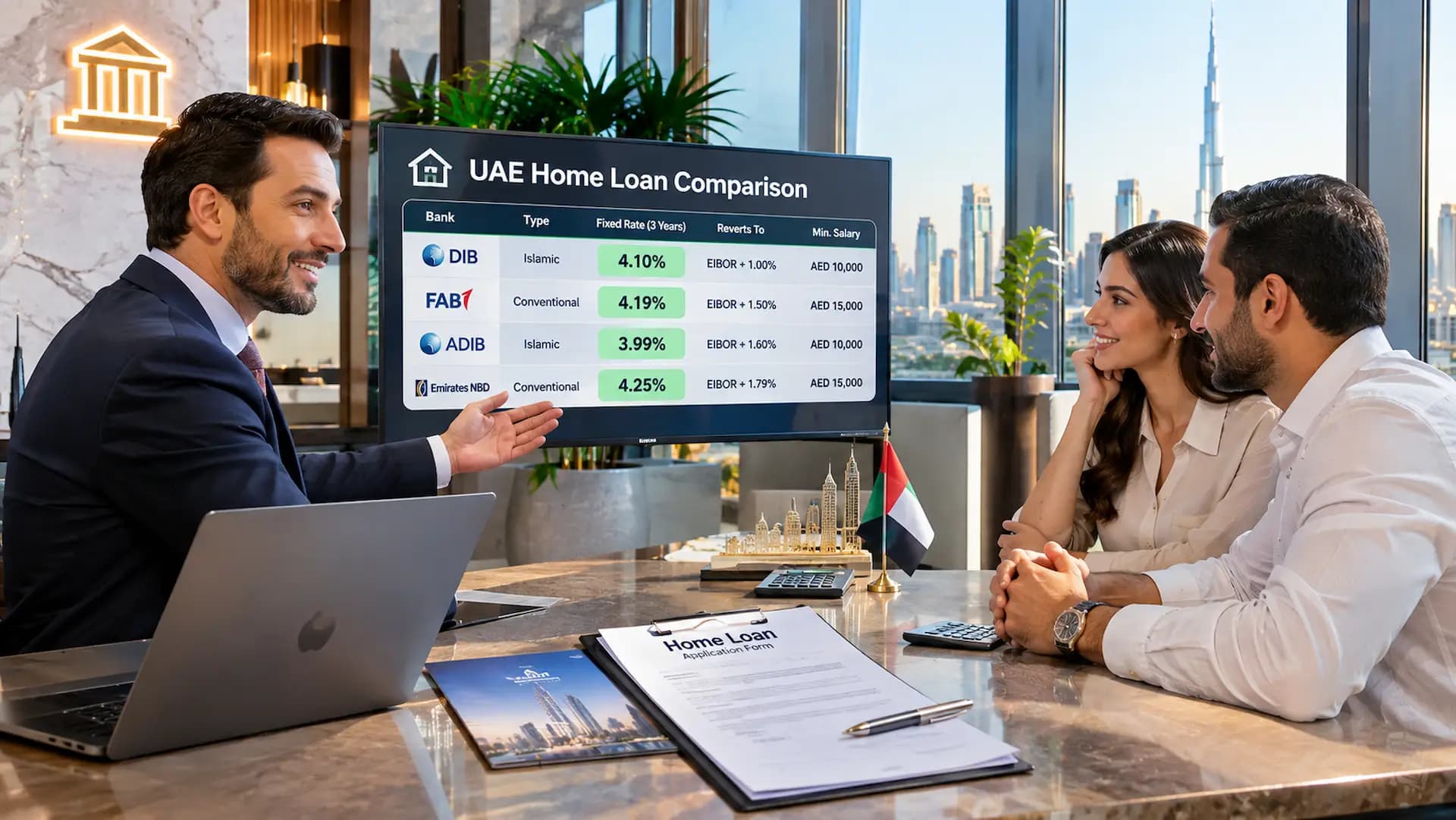
Two things to notice. First, the headline rates are tightly bunched: most of the market sits between 3.95% and 4.3% for a three-year fix. Second, the reversion margins are not: they run from 1% to almost 2%, and that is where the real differences in cost lie. How Islamic and conventional pricing compare is set out in Islamic vs conventional mortgages, and live rates are tracked in UAE mortgage rates.
Illustrative. Excludes processing fees, which are compared below, and insurance. Assumes EIBOR holds at early-November 2026 levels. You can run your own figures on our mortgage calculator.
The lesson is clear: the cheapest five-year deal started at 4.10%, not 3.99%, because its margin after the fixed period is so much lower. HSBC, with the highest starting rate of the three-year fixes, finishes level with several 3.99% offers for the same reason. Between first and tenth place, the difference is about AED 43,000 over five years on the same loan.
If you plan to refinance as soon as the fixed period ends, the starting rate matters more and the margin less. If you might stay, the margin matters most. How EIBOR moves is explained in 3-month EIBOR in the UAE, and when it pays to move at the end of a fixed period in when to refinance your mortgage.
Figures above 80% generally apply to UAE nationals or specific first-time buyer offers. Whatever a bank publishes, the Central Bank’s limits are the ceiling: for an expatriate, 80% on a first home up to AED 5 million, less above that, for second homes and for off-plan. The full rules are in UAE mortgage LTV rules.
Minimum salary is only the entry ticket. What you can actually borrow depends on the Central Bank’s 50% debt burden limit, the bank’s stress rate and whether your employer is on its approved list. The full eligibility picture is in the UAE mortgage eligibility guide.
FAB’s margin after the fixed period also rises, from EIBOR plus 1.5% to EIBOR plus 1.89%, without salary transfer. If you are happy to move your salary, that is usually worth doing. If you are self-employed or prefer to keep your account elsewhere, compare banks on their non-salary-transfer pricing, which can rank quite differently.
The short answer: best bank by situation
| If you want… | Banks that stand out in late 2026 |
| The lowest cost over five years | Dubai Islamic Bank, ADIB, First Abu Dhabi Bank |
| The lowest headline fixed rate | Sharjah Islamic Bank: 3.75% fixed for one year |
| The lowest margin after the fixed period | Dubai Islamic Bank (EIBOR + 1.00%) and HSBC (EIBOR + 1.09%) |
| A low minimum salary | ADCB and Emirates Islamic for UAE nationals (from AED 8,000); ADIB from AED 10,000 with salary transfer; CBD from AED 12,000 |
| A loan as a non-resident | ADCB publishes non-resident terms: up to 50% of value, up to AED 15 million, over up to 15 years |
| A long fixed rate | FAB and CBD at 4.19% for five years; Sharjah Islamic Bank at 4.25% |
| Islamic home finance | Dubai Islamic Bank, ADIB, Sharjah Islamic Bank, Emirates Islamic, Ajman Bank |
| Low upfront fees | FAB, which waives processing fees for salaried first-time buyers until 31 December 2026; several banks offer zero-fee deals through brokers |
| The largest loan as a first-time buyer | FAB lists up to 85% for first-time buyers |
Rates compared: what you pay, and what it becomes
Every UAE mortgage has two rates: the fixed rate you start on, and the rate it reverts to when the fixed period ends, usually a margin over EIBOR. Here are three-year fixed rates for salaried borrowers who transfer their salary, as reported by broker rate trackers in late September and early October 2026, and the margins they revert to.| Bank | Type | 3-year fixed | Reverts to |
| Dubai Islamic Bank | Islamic | 3.95% to 4.10% | 3M EIBOR + 1.00% |
| First Abu Dhabi Bank | Conventional | 3.99% | 3M EIBOR + 1.50% |
| ADIB | Islamic | 3.99% | 1M EIBOR + 1.60% to 1.85% |
| Sharjah Islamic Bank | Islamic | 3.99% (3.75% for one year) | 3M EIBOR + 1.75% |
| Emirates Islamic | Islamic | 3.99% | 3M EIBOR + 1.79% |
| Commercial Bank of Dubai | Conventional | 3.99% | 3M EIBOR + 1.79% |
| RAKBANK | Conventional | 3.99% broker-reported; 4.69% published | 3M EIBOR + 1.69% |
| United Arab Bank | Conventional | 4.19% | 3M EIBOR + 1.79% to 1.99% |
| Arab Bank | Conventional | 4.25% | 6M EIBOR + 1.89%, floor 3.24% |
| Emirates NBD | Conventional | 4.29% (4.19% for two years) | 1M EIBOR + 1.99% |
| HSBC | Conventional | 4.39% | 3M EIBOR + 1.09% to 1.69% |
| Mashreq | Conventional | 4.49% for two years | 3M EIBOR + 1.75%, floor 4.49% |
The five-year cost ranking
Most people keep a mortgage for longer than its fixed period. So a fairer test than the headline rate is what each offer costs over five years: three years fixed, then two years at the reversion rate. Here is that comparison for a AED 1.6 million loan over 25 years, assuming EIBOR stays where it was in early November 2026 (1-month about 4.09%, 3-month about 4.32%, 6-month about 4.65%).| Rank | Bank | Starting payment | Payment after the fixed period | Interest over five years |
| 1 | Dubai Islamic Bank (4.10%, then + 1.00%) | AED 8,534 | AED 9,541 | AED 343,900 |
| 2 | ADIB (3.99%, then 1M + 1.60%) | AED 8,437 | AED 9,847 | AED 349,500 |
| 3 | First Abu Dhabi Bank (3.99%, then + 1.50%) | AED 8,437 | AED 9,960 | AED 353,300 |
| 4 | Sharjah Islamic Bank (3.99%, then + 1.75%) | AED 8,437 | AED 10,178 | AED 360,600 |
| 5 | HSBC (4.39%, then + 1.09%) | AED 8,794 | AED 9,646 | AED 360,800 |
| 6= | Emirates Islamic / CBD (3.99%, then + 1.79%) | AED 8,437 | AED 10,213 | AED 361,800 |
| 8 | United Arab Bank (4.19%, then + 1.79%) | AED 8,614 | AED 10,234 | AED 371,600 |
| 9 | Emirates NBD (4.29%, then 1M + 1.99%) | AED 8,704 | AED 10,218 | AED 375,700 |
| 10 | Arab Bank (4.25%, then 6M + 1.89%) | AED 8,668 | AED 10,623 | AED 387,300 |
| 11 | Mashreq (4.49% for two years, then + 1.75%) | AED 8,884 | AED 10,280 | AED 410,100 |
Minimum salary and maximum loan by bank
The cheapest bank is no use if it will not lend to you. Here is what the main lenders publish on their own websites, as checked in mid-October 2026:| Bank | Minimum monthly salary | Maximum financing published |
| ADCB | AED 8,000 for UAE nationals; AED 15,000 for expatriates; non-residents need AED 200,000 held with the bank | 85% nationals; 80% expatriates; up to 50% non-residents |
| Emirates Islamic | AED 8,000 to AED 20,000, depending on residency | 85% nationals; 80% expatriates |
| ADIB | AED 10,000 with salary transfer; AED 15,000 without | Up to 85% |
| Commercial Bank of Dubai | AED 12,000 salaried; AED 20,000 self-employed | Up to 85% |
| First Abu Dhabi Bank | AED 15,000 | 85% for first-time buyers; otherwise 80% |
| Emirates NBD | AED 15,000 | 80% |
| RAKBANK | AED 15,000 | 80% |
| HSBC | AED 15,000 (premium segments from AED 30,000) | Up to 80% |
| Standard Chartered | AED 15,000 | 80% nationals; 75% expatriates |
| Bank of Baroda | AED 25,000 | 85% nationals; 80% expatriates |
Fees compared
Processing fees vary more than most people expect:- Emirates NBD shows a processing fee of 1.05% of the loan, including VAT, in its key facts statement: AED 16,800 on AED 1.6 million.
- First Abu Dhabi Bank waives the processing fee for salaried first-time buyers until 31 December 2026.
- Several banks, including Dubai Islamic Bank, ADIB, Sharjah Islamic Bank, Mashreq and RAKBANK, were listed with a 0% bank fee by a UAE comparison site in November 2026, while others were listed at around 0.26% to 0.52%. Confirm the fee in your own offer letter.
What salary transfer is worth
Most banks price better if you move your salary to them. Two published examples:| Bank | With salary transfer | Without | Extra monthly cost on AED 1.6 million |
| Emirates NBD (2-year fix) | 4.19% | 4.59% | About AED 361 |
| First Abu Dhabi Bank (fixed) | 3.99% | 4.24% | About AED 222 |
Beyond the rate: what makes a bank right for you
- Employer listing. Banks keep lists of approved employers. If yours is on a bank’s list, you may get better terms and a smoother approval; if not, some banks will still lend, others will not.
- Self-employed appetite. Some lenders are far more comfortable with business owners than others, and each assesses business income differently. That can matter more than the rate; see self-employed mortgages in Dubai.
- Non-resident lending. Only some banks lend to buyers living abroad, usually at 50% to 60% of value and with higher income requirements. Which banks do, and on what terms, is covered in UAE banks that lend to non-residents.
- The property. Off-plan, older buildings, villas in certain communities and properties in other emirates are financed by some banks and not others.
- The benchmark. ADIB and Emirates NBD reference one-month EIBOR, most banks three-month, and Arab Bank six-month. Shorter benchmarks move faster when rates change.
- Floors. Some reversion rates have a minimum, such as Mashreq’s 4.49% or Arab Bank’s 3.24%, which stops your rate falling below that level even if EIBOR drops.
- Flexibility. Overpayment allowances, how quickly the bank responds and how it handles a later buyout or top-up all affect your experience long after the rate is forgotten.
Best bank by borrower profile
Salaried expatriate, first home, salary of AED 25,000 or more. You have the widest choice. Start with the lowest five-year cost (in late 2026, Dubai Islamic Bank, ADIB and FAB) and check whether your employer is on each bank’s approved list, since that can improve both the rate and the speed of approval. UAE national. Look for the banks that publish the full 85% for nationals and low salary thresholds, such as ADCB and Emirates Islamic from AED 8,000, and ADIB. Nationals may also be eligible for government housing programmes that some banks administer alongside their own home finance. Salary between AED 10,000 and AED 15,000. Your shortlist is shorter: ADIB from AED 10,000 with salary transfer, CBD from AED 12,000, and, for nationals, ADCB and Emirates Islamic. On a smaller loan, a fixed processing fee takes a bigger bite, so zero-fee offers matter more. Self-employed. Policy matters more than price. CBD publishes a AED 20,000 minimum for self-employed applicants; other banks assess business income in very different ways, and you will usually be priced without the salary-transfer discount. Living abroad. Only some banks lend to non-residents. ADCB publishes clear terms, and international banks such as HSBC suit buyers with an existing relationship. Expect 50% to 60% of value and a higher income threshold. Planning to sell or refinance within three years. Put more weight on the starting rate and the fee, and less on the margin you would revert to. A zero-fee three-year fix at 3.99% is hard to beat for this profile. Wanting certainty. Five-year fixes were available from FAB and CBD at 4.19% and Sharjah Islamic Bank at 4.25% in late 2026. You pay a little more at the start for protection against rising rates. The trade-offs are in fixed vs variable mortgages in the UAE. Buying off-plan. The bank must have approved your project, before completion or at handover. Check that first; the best rate is irrelevant if the lender will not finance the building. How that works is explained in off-plan mortgages in Dubai.How to choose, in four steps
- Shortlist banks that will lend to you, based on salary, employer, residency and property type.
- Compare the five-year cost, not the headline rate, using the fixed rate, the reversion margin and the benchmark.
- Add the fees, especially the processing fee, and check the floor.
- Weigh the practical factors: salary transfer, Islamic or conventional, flexibility and speed.