Mortgage Meaning in the UAE: Every Term Explained

Mortgage5 min read· 23 Sept 2026
Mortgage Meaning in the UAE
A mortgage is a loan secured against property. You borrow, the lender registers a legal interest in the property as security, and if you stop repaying they can ultimately recover their money from it. That much is the same everywhere. What differs is the vocabulary. A UAE mortgage brings terms you won’t have met elsewhere — DBR, Oqood, Ijara, Taqeemi, Form F — alongside familiar ones used slightly differently. Bank staff use them assuming you know them, and most people nod along rather than ask. This page defines every term you’re likely to encounter, grouped by where in the process it appears rather than alphabetically, so you can jump to the stage you’re actually at.

Eligibility and affordability

Pre-approval

A conditional written statement from a bank confirming how much it’s willing to lend you, based on your finances rather than any specific property. Also called approval in principle, in-principle approval, AIP or decision in principle. Takes two to five working days and usually stays valid 60 to 90 days.

DBR (Debt Burden Ratio)

The share of your gross monthly income committed to debt repayments, including the mortgage you’re applying for. The Central Bank caps it at 50%. This is the limit that decides most loan amounts.

LTV (Loan to Value)

The percentage of the property’s value a bank will lend. An expat buying a first home under AED 5 million can borrow up to 80%; above that, 70%. Off-plan is capped at 50% for everyone. The tiers are set out in our guide to UAE mortgage LTV rules.

AECB / Etihad Credit Bureau

The federal credit bureau. Holds every active and closed credit facility, up to 36 months of payment history, bounced cheques and court judgments. Every lender pulls your report as a mandatory step.

Credit score

A 300 to 900 rating issued by the bureau. No published universal minimum for a mortgage, but approval odds improve noticeably above 650 to 700. See how to check your credit score and the minimum score you need.

Cheque Score

A separate bureau score measuring returned-cheque risk. Banks pull both this and your credit score, and most guides never mention it.

Liability letter

A statement from a lender confirming exactly what’s outstanding on a facility. You’ll need these for your own debts at application, and the seller needs one from their bank if the property is mortgaged. The single most common cause of delay in a UAE transaction.

Income multiple

A cap on borrowing relative to annual income, roughly seven times for expats and eight for UAE nationals. Applies alongside LTV and DBR; the lowest of the three decides your loan.

Stress test

Assessing affordability at a rate above the one you’re offered, typically 2 to 4 percentage points higher. Where a fixed period applies, the test runs against the reversion rate rather than the introductory rate.

Income haircut

A reduction banks apply to self-employed earnings before calculating affordability, commonly 20% to 40%. The main mechanical reason profitable business owners get smaller offers than expected.

Salary transfer

An arrangement where your salary is paid into the lending bank. Usually worth 0.10% to 0.25% off the rate, and some banks waive processing fees entirely for transfer customers.

Salary certificate

An employer letter confirming your employment and pay, valid 30 days. Distinct from a salary transfer letter, which is addressed to a specific bank and commits your employer to route your salary there.

Tenor

The loan term. Capped at 25 years in the UAE, with a maximum age at final repayment of around 65 for salaried borrowers and 70 for self-employed. Covered in depth: how the debt burden ratio works, mortgage pre-approval in Dubai and UAE home loan eligibility.

The loan itself

Mortgagor

The borrower. You. Easy to mix up, so: the mortgag-or is the one who takes out the loan.

Mortgagee

The lender. The bank holding the security.

Principal

The amount borrowed, excluding interest. Your monthly payment reduces it gradually.

Amortisation

The process of repaying a loan through regular instalments covering both interest and principal. Early payments are mostly interest; later ones mostly principal.

Equity

The share of the property you own outright. Purchase price minus outstanding loan, adjusted for any change in value.

Fixed rate

An interest rate locked for a set period, commonly one to five years. Predictable, but it ends.

Variable rate

A rate that moves with a benchmark, expressed as EIBOR plus a margin. Rises and falls with the market.

EIBOR

Emirates Interbank Offered Rate, the benchmark UAE variable mortgages track. Most commonly the three-month rate. Because the dirham is pegged to the dollar, it broadly follows US rate movements with a lag.

Margin (or spread)

The fixed percentage a lender adds to EIBOR. Quoted as “EIBOR + 1.50%”. The margin stays constant; EIBOR moves.

Reversion rate

What you pay once a fixed period ends, usually EIBOR plus a margin. Often the most important number in the whole offer, because you live with it for most of the loan’s life, and it’s the rate your affordability is stress-tested against.

Re-fixing frequency

How often a variable rate resets against the benchmark: monthly, quarterly or half-yearly. Determines how quickly a rate change reaches your payment.

Early settlement fee

Charged when you repay early or refinance. Capped at 1% of the outstanding balance or AED 10,000, whichever is lower.

Buyout

Local term for switching your mortgage to another lender, also called a balance transfer. No 4% transfer fee applies, because the property doesn’t change hands.

Equity release

Borrowing against equity you’ve built up, also called a top-up. Treated as new lending, so the same LTV and DBR limits apply.

FOL (Final Offer Letter)

The bank’s binding commitment, issued after valuation and final checks. Sets out the loan amount, rate, term and conditions. Distinct from pre-approval, which is conditional.

Disbursement

Release of the loan funds. For a ready property this happens at the transfer appointment; for off-plan it’s staged against construction milestones. Covered in depth: fixed versus variable mortgages, how EIBOR affects your rate and UAE mortgage rates in 2026.

Islamic home finance

Ijara

A lease-to-own structure. The bank buys the property and leases it to you, with ownership transferring once payments are complete. In a genuine Ijara the bank bears ownership risk during the lease, which is the test that distinguishes it from a relabelled conventional loan.

Murabaha

Cost-plus sale. The bank buys the property and sells it to you at an agreed mark-up, payable in instalments. The total cost is fixed at the outset.

Diminishing Musharakah

A declining partnership. You and the bank co-own the property, and you buy out the bank’s share progressively while paying rent on the portion you don’t yet own.

Forward Ijara

Used for property still under construction, with rent fixed during the build period. Istisna is the related manufacturing or construction contract.

Profit rate

The Islamic finance equivalent of an interest rate. Functionally comparable in cost terms, structurally different in how it arises.

Product fatwa

A ruling from a bank’s Sharia board confirming a product is compliant. Worth asking whether one exists covering the construction phase specifically, since that’s where structures vary most. Covered in depth: how Islamic mortgages work in the UAE and our Islamic home finance options.

The transaction

DLD (Dubai Land Department)

The government registry. Every transfer, mortgage registration and title deed goes through it.

RERA

The Real Estate Regulatory Agency, the DLD’s regulatory arm. Licenses brokers and valuers, governs listings and escrow. It regulates; it does not adjudicate disputes.

Form A

The agreement between a seller and their broker authorising marketing. Maximum 90 days, renewable. A property can carry up to three, provided each is non-exclusive.

Form B

The buyer’s equivalent, appointing an agent to search and negotiate.

Form F

The unified sale contract between buyer and seller, commonly called the MOU. Legally binding once signed. Can only be generated through the Dubai REST app or a trustee centre by a RERA-certified agent.

Form I

Used when two brokerages collaborate, setting out the commission split. Form U is the only legally recognised way to terminate a broker agreement.

MOU

Memorandum of Understanding. In Dubai practice this means Form F, not an informal letter of intent.

NOC (No Objection Certificate)

Developer confirmation that service charges are clear and the sale can proceed. Takes three to seven working days, obtained by the seller. No transfer registers without it.

Title deed

The legal proof of ownership, issued by the DLD. Where you have a mortgage, the bank holds it until the loan is repaid.

Oqood

The interim registration record for off-plan property, converting to a full title deed at handover. Verify yours is issued after you sign the SPA.

SPA (Sale and Purchase Agreement)

The contract used when buying off-plan directly from a developer, in place of Form F.

Registration trustee office

A licensed private centre that executes transfers on the DLD’s behalf. Distinct from a real estate services trustee, which handles Ejari, valuations and title deed amendments but cannot complete a sale. Booking the wrong one wastes the appointment.

Blocking

Registering a hold on a title deed so the property can’t be sold elsewhere while a seller’s mortgage is being settled.

Manager’s cheque

A bank-guaranteed cheque, also called a cashier’s cheque. The standard payment instrument at transfer. Since DLD Circular No. 29/R/2025, the cheque for sale proceeds must be issued to the registered owner and paid into a UAE account in that name.

POA (Power of Attorney)

Authority for someone to act on your behalf. Must be properly attested and specifically cover the named property. A defective POA is among the most common reasons a transfer fails on the day.

Encumbrance

Any claim registered against a property, such as a mortgage or a caution, that restricts a clean transfer.

Bank valuation

An independent appraisal commissioned by your lender to set the loan amount. The bank lends against the lower of purchase price and valuation.

Taqeemi certificate

The DLD’s official valuation certificate, and the only one accepted by government entities, courts and immigration authorities. Separate from your bank’s valuation, which has no standing outside the loan.

Ejari

The DLD’s rental contract registry. Mandatory if you rent the property out, and useful as proof of occupancy for visa renewals and school registrations.

Escrow account

A DLD-controlled account holding off-plan buyer payments, released to the developer only against verified construction progress. Covered in depth: buying property in Dubai and Form F: what you’re signing.

Costs and fees

DLD transfer fee

4% of the sale price. Legally split between buyer and seller, though in practice buyers commonly pay it in full. Cannot be financed into the mortgage.

Trustee fee

The registration trustee’s service charge, around AED 4,000 plus VAT above a AED 500,000 sale value. Separate from the 4%.

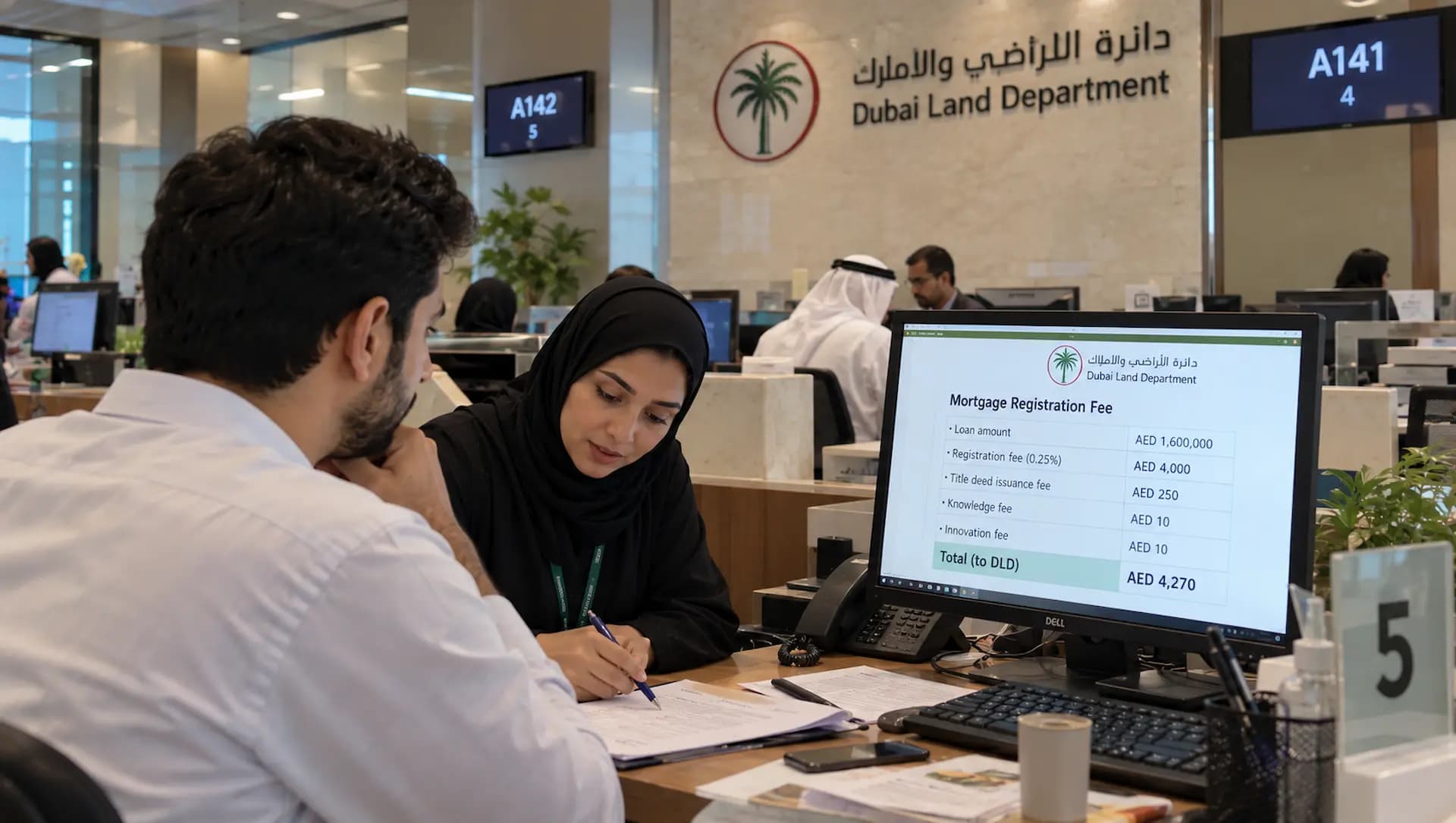
Mortgage registration fee

0.25% of the loan amount in Dubai, 0.1% in Abu Dhabi, paid at transfer.

Processing or arrangement fee

The bank’s charge for setting up the loan, typically 0.5% to 1%, occasionally waived in a promotion.

Agency commission

Conventionally 2% plus VAT, paid by the buyer. Also cannot be financed.

Service charges

Annual building or community fees, ranging from roughly AED 3 to over AED 60 per square foot. Arrears block the NOC, and some banks factor them into affordability.

Mortgage life insurance

Required by every UAE lender, commonly 0.4% to 0.8% of the declining balance per year. You are not obliged to buy it from your lender. Covered in depth: UAE expat mortgage rules and fees.

Property types and ownership

Freehold

Outright ownership of the property and the land, available to all nationalities in designated areas.

Leasehold

Ownership for a fixed term, typically up to 99 years, with the land reverting to the freeholder.

Off-plan

Property bought before completion, directly from a developer. LTV capped at 50%, payments tied to construction milestones.

Ready property

A completed unit with a title deed issued. Easier to finance and faster to transfer.

Secondary market

Resale property, bought from an existing owner rather than a developer. Uses Form F and the trustee transfer process.

Handover

The formal transfer of an off-plan property from developer to buyer, including documentation, final payment and title deed issuance. Distinct from possession, which is physically occupying the unit.

Still unsure about a term?

Vocabulary aside, the questions that actually decide your mortgage are how much you can borrow and which lender fits your profile. Those don’t come from a glossary. We work across 15+ UAE lenders and will tell you plainly where you stand, in language that doesn’t need translating. Get pre-approved, or speak to a consultant if you’d rather ask questions first. If you’re starting from the beginning, our guide to getting a mortgage in Dubai walks the whole process from pre-approval to title deed.